Despite much-needed investment in rural areas to curb rapid urbanisation, sprawling informal settlements remain a fact of life in Africa. Dr Mark Napier, an expert in human settlements and housing at the CSIR, says authorities should face this reality head-on through sustainable human settlement planning so that all urbanites, even temporary shack dwellers, are protected from climate threats and have access to basic services.
“People moving to cities for better opportunities in southern Africa regions are not finding a place to live in the formal system, because land is not made available to people who can’t afford it, and it’s expensive to service the land,” says Napier, who has documented land access in African cities.
“The result is overcrowding, the ongoing growth of backyard shacks and informal settlements, illegal land occupations, and communities continuing to live in unsafe areas, such as floodplains,” he says.

“All of this is evidence that the formal system is not working, and African cities are not coping.”
On 10 June 2025, severe rains ravaged the Eastern Cape province of South Africa, killing over 90 people and displacing thousands more. The city of Mthatha was worst affected, with many homes built in the floodplain of the Mthatha River suddenly under water.
Napier says this disaster, still fresh in the minds of parents who spent days afterwards searching for their children in the ruins, is just the latest reminder that vulnerable populations in informal settlements are most at risk to extreme weather events and rising temperatures exacerbated by climate change.
“According to satellite imagery analysis, more than 20% of residential structures in South Africa are made from temporary materials like corrugated iron and timber,” he says. “With temperatures set to reach up to 40 °C in summer in some regions, the heat is unbearable.”
Napier studied informality in towns and cities extensively over the last three decades. He has visited families living in shacks where the elderly, children and people with disabilities suffer immensely during heatwaves without adequate access to clean water or sanitation.
His research suggests that one of the first steps to ensuring that urban areas are more resilient to a changing climate is to accept the reality of informal settlements.
“Informal settlements must first be recognised and then regularised.” Regularisation means incorporating a settlement into the formal legal and administrative processes of a municipality, including establishing land ownership, providing basic services, and upgrading infrastructure.
“The city of eThekwini in KwaZulu-Natal has been very good at prioritising the most vulnerable settlements for emergency services and then identifying which settlements can be regularised over time,” he says.
Other municipalities can learn from its approach: establish townships, subdivide the land with community consultations and install emergency services first, with permanent services later.
“Then you start building a community both in the physical and social sense, and that will consolidate over time as people have the security to invest,” says Napier.
In terms of upgrading infrastructure, he adds, recent scientific innovations in green building materials and practices mean that governments can now use modern, affordable technologies to provide water, sanitation, internet access, energy and shelter in informal settlements.
"We can upgrade settlements in the old way without any innovation, or we can do it in ways that are much more environmentally friendly and result in less carbon emissions,” he says. “In other words, green infrastructure is as relevant to addressing informality as it is to general city planning."
One such innovation in green building materials was recently unveiled by the CSIR and its partners as part of a circular economy initiative: interlocking bricks made of 70% recycled waste, including crushed waste glass, and construction and demolition waste. Building with these LEGO®-like bricks is cost-effective, requires no cement, and their internal hollows automatically create channels for electrical and water pipes. Even those with minimal building experience can easily assemble or disassemble houses, and the bricks can be reused in new structures or recycled again.
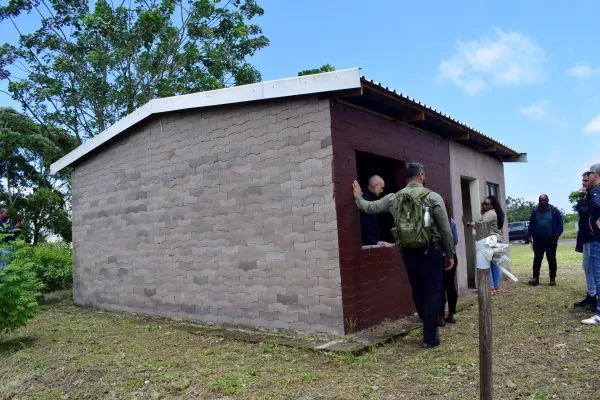
“When people feel more secure, they themselves will invest in more green and well-performing materials, and they'll feel more permanent,” says Napier, who co-authored a recent CSIR study on creating more resilient, liveable human settlements through a circular economy.
He acknowledges, though, that regularising informal settlements is expensive, with complexities to navigate. “This includes issues like sorting out underlying land ownership issues, neighbours negotiating plot sizes, and people sometimes needing to remain mobile in a changing job market, which influences a household’s urban commitment.”
The key, he says, is for authorities, non-governmental organisations, professionals and scientists across disciplines, public engagement experts, communities and traditional leaders to work together.
“When we as researchers develop technologies, for example, we can’t work in isolation – we must work within the reality of urbanisation, the daily realities experienced by people living in informal settlements and the reality of environmental pressures.”
This research into sustainable and liveable urban environments has been funded by international research organisations (bilateral and multilateral), the national Department of Human Settlements, and most recently by the Circular Economy Demonstration Fund, which is administered by the CSIR-hosted Circular Innovation South Africa programme on behalf of the DSTI. It addresses SDG 11.
-ENDS-
For enquiries, contact:
Dr Mark Napier: CSIR expert
Email: @email
About the CSIR:
The CSIR, an entity of the Ministry of Science, Technology and Innovation, is one of the leading scientific and technology research, development and implementation organisations in Africa. Constituted by an Act of Parliament in 1945 as a science council, the CSIR undertakes directed and multidisciplinary research and technological innovation, as well as industrial and scientific development, to improve the quality of life of all South Africans. For more information, visit www.csir.co.za.
Follow us on social media:
X: @CSIR. Facebook: CSIRSouthAfrica. Instagram: CSIRSouthAfrica. LinkedIn: Council for Scientific and Industrial Research (CSIR). YouTube: CSIRNewMedia
For media enquiries, contact:
Phetolo Phatsibi
Email: @email