Low-cost and rugged, it grows as you grow.
CSIR robotics engineers announced they are working on a reconfigurable, low-cost and rugged prototype mobility device called Buddy4Life, which will assist children, adults and caregivers affected by cerebral palsy.
The device, which is destined for local manufacture, will help reduce preventable deformities caused by improper seating. It will also make seating adjustments easier for carers.
Dr Sunveer Matadin, a lead robotics researcher at the CSIR, explains that mobility aids are lifelines for families of children living with cerebral palsy. Unfortunately, assistive devices currently on the market are often unaffordable, with families needing to purchase larger ones as children grow.
“The size of these expensive existing devices is fixed, so children outgrow them and may develop deformities if they cannot get access to a larger, appropriately sized wheelchair at the next stage of life,” he says.
In addition, existing mobility devices can only provide support to toddlers from about age two, and not from infancy. “This is a major cause of deformity because by the time a child is fitted for a mobility device, their muscles may have already developed imbalances or grown at different rates compared to their skeleton,” says Matadin.
The CSIR Buddy4Life is novel in that even a baby can be seated in it, and it can then be adjusted for size as the child grows. “There is nothing like this in the local market – it is designed to last a lifetime, supporting children from infancy through adulthood.”
The concept was inspired by a heartfelt plea in 2024 from community health worker and disability consultant Ruth Stubbs. She works with The Paige Project, a non-profit organisation that supports individuals and families affected by cerebral palsy.
“Early intervention is critical. If we don't intervene, deformities start setting in – you start getting scoliosis, which is the curvature of the spine; you start getting kyphosis; you get obliquity of the hips, of the pelvis. And these cause additional secondary complications to the existing diagnosis,” says Stubbs.
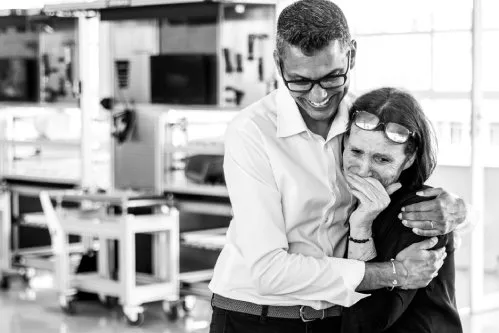
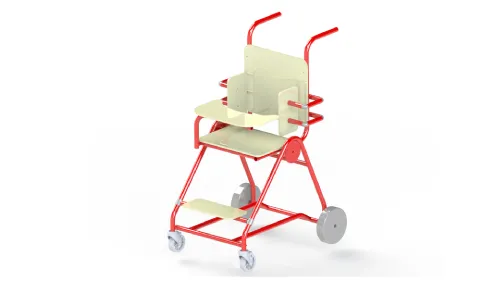
Matadin’s team invited Stubbs to advise them on how an ideal mobility device would function to support children with CP as they grow, and they surprised her with a prototype on 26 November 2025. It features easy-to-adjust trunk supports, a footrest, a tray table, brakes and more.
“All the ideas and all the discussions that have happened over the last few months; there isn't one thing that hasn't been included,” said Stubbs in response to the surprise reveal. “It’s like a magic wand!”
Matadin says the current prototype is an outcome of phase one of the project, which is intended to provide relief in severely resource-constrained communities. It has been specifically designed to be easy to manufacture locally and incorporates light-weight, low-cost, but hardy materials.
“This is about helping children and adults with cerebral palsy as well as their families, but it is also about enabling small businesses to generate income by making this product locally,” says Matadin.
In phase two of the project, the CSIR’s robotics experts will integrate smart features, pneumatics and artificial intelligence, which will all help reduce frequent specialist callouts to help carers correctly seat children.
“The positive there is that the information can be sent to a central office where a specialist like Ruth, for example, could remotely direct even a non-expert to adjust the device,” he says.
Matadin stresses that a simple, robust design remains his team’s priority.

“Designing such a simple product to solve a complex problem really put our engineering and robotics know-how to the test,” says Matadin, explaining that it is relatively easy to make something functional with fancy mechanics and robotics, but designing a lightweight, simple-to-use, and easy-to-manufacture device with all the required degrees of freedom is far more difficult.
“So, this work is not out of place amid the work we do in space robotics, wearables like exoskeletons, and human-in-the-loop automation,” says Matadin.
The team opted for a manual reconfiguration system in the prototype that is very simple, robust and does not require tools: a caregiver adjusts Buddy4Life’s side supports by loosening and tightening built-in screws.
“This design is going to make it a lot easier for a caregiver to make the necessary adjustments,” says Stubbs. “What's so amazing about it is that it grows and expands with the child, so it's economical, it's affordable, it's practical, and it speaks to seating that the family can get involved in and understand.”
Matadin’s team envisions that the two phases of the CSIR Buddy4Life project will help create an ecosystem that not only supports children who need it most in rural areas but can be scaled to benefit both resource-constrained and affluent communities worldwide.
“This is not only for poor communities, because if you have a standardised platform like this, even the richest of the rich will still benefit,” says Matadin.
Stubbs and Matadin say they will now work together to trial the prototype Buddy4Life in the field to inform further design improvements and to see how the device will address challenges carers face with existing mobility devices.
Stubbs explains: “If you put a child in and the child sits, is the footrest going to hold a spasm? Is the centre of gravity in place? Is it comfortable? Is there good head control? Is there good trunk control? Are they then able to bring their hands up onto the table and be interactive? Can they start self-feeding? How easy is it going to be for mom or a caregiver to transport it through the streets? Is it going to fit into a shack? Is it going to fit into an RDP house?”
On behalf of the CSIR team, Matadin invites non-profits, corporate social investment programmes, government and industry to support the technology development, manufacturing and distribution of the device as partners in the Buddy4Life project.
As with other technologies developed at the CSIR, the design will eventually be licensed to local manufacturers.
More information about our research, facilities and services: https://www.csir.co.za/what-we-do/manufacturing/robotics-and-smart-manufacturing
Contact Person:
Dr Sunveer Matadin, SMatadin@csir.co.za