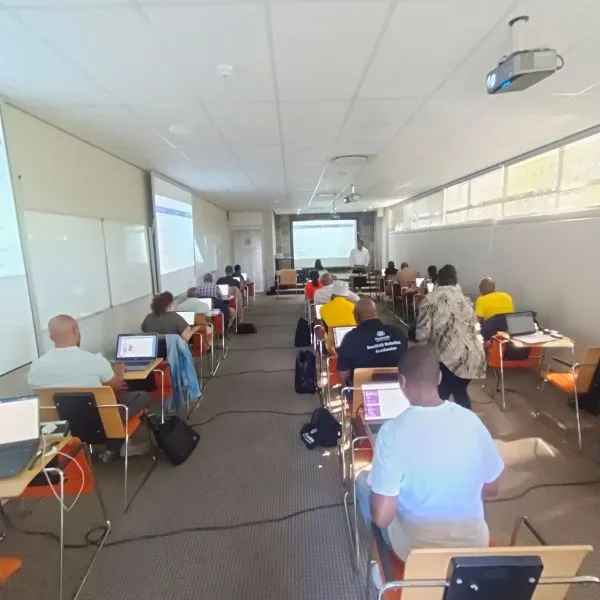
Forty provincial educational specialists responsible for the robotics and coding subject from eight provinces are attending the Department of Science, Technology and Innovation’s (DSTI) Coding and Robotics Workshop at the Centre for High Performance Computing (CHPC) in Cape Town. The training runs from 23 – 27 March 2026.
A bit of context
The workshop forms part of a three-year contract awarded to the CHPC by the DSTI to deliver training workshops in support of implementing the new coding and robotics curriculum for the Department of Basic Education (DBE).
The official launch of the curriculum followed a phased timeline of approval, piloting and formal gazetting. The reconceptualised Curriculum and Assessment Policy Statement (CAPS) was endorsed by Umalusi for full rollout in the Foundation Phase starting in 2025. Extensive piloting has taken place in more than 1 500 public schools across all nine provinces to test the draft curriculum for Grades R – 9.
The new curriculum aims to prepare learners for science, technology, engineering, arts and mathematics (STEAM) careers by fostering:
• Computational thinking: Solving complex problems through logic;
• Design thinking: Creating human-centred solutions and encouraging innovation; and
• Digital citizenship: Understanding the societal impact of technology and promoting ethical usage.
The hands-on programme covers:
• Day one: Scratch programming fundamentals and computational thinking
• Day two: Advanced Scratch and classroom integration (lesson plans, classroom activity templates and assessment strategies)
• Day three: Physical computing with Arduino using Scratch for Arduino
• Day four: Robotics (building a robotic arm project) and Community Code Club coordination
• Day five: Introduction to Micro:bit and DBE curriculum integration planning
Upon completion, participants will be able to:
• Teach foundational coding and robotics concepts to students;
• Integrate coding and robotics into existing DBE curriculum subjects; and
• Independently run similar workshops in their provinces, districts and schools.
Why training provincial subject advisors matters
The CHPC has recently completed a similar three-year robotics and coding contract with the DSTI during the planning and piloting phase of the new curriculum, “Training educational sepcialists is a critical step in the DSTI’s strategy because they serve as the primary bridge between national policy and classroom practice. They are responsible for training teachers in their respective districts,” said Koki Selepe, Deputy Director: Science Promotion at the DSTI.
In the previous contract, a cohort of 220 trainees were successfully trained and is now equipped to establish coding and robotics programmes and initiatives in their respective regions. This demonstrates the effectiveness of the train-the-trainer model used in the programme.
“They ensure that the new CAPS is correctly interpreted and implemented uniformly across all schools, preventing misconceptions,” said Mthetho Sovara, senior research support scientist and project lead for the Coding and Robotics Workshop.
Published 27 March 2026