Relief is underway for wildfire-prone areas in the Western Cape and Catalonia in Spain with the Mediterranean Climate Action Partnership Mini-Sprint project that will enhance landscape resilience and address the impacts of damaging wildfires.
With a focus on climate change adaptation, and with support from other Mediterranean regions (Central Chile, New South Wales in Australia and Southern California in the USA), the Mini-Sprint initiative has developed an integrated Mediterranean Fire Risk Information Management System (MFRIMS) as a future predictive capability tool to help decision-makers plan for, manage and respond to wildfires, to protect the built and natural infrastructure of ecosystems at risk from disastrous wildfires in these Mediterranean climate regions.
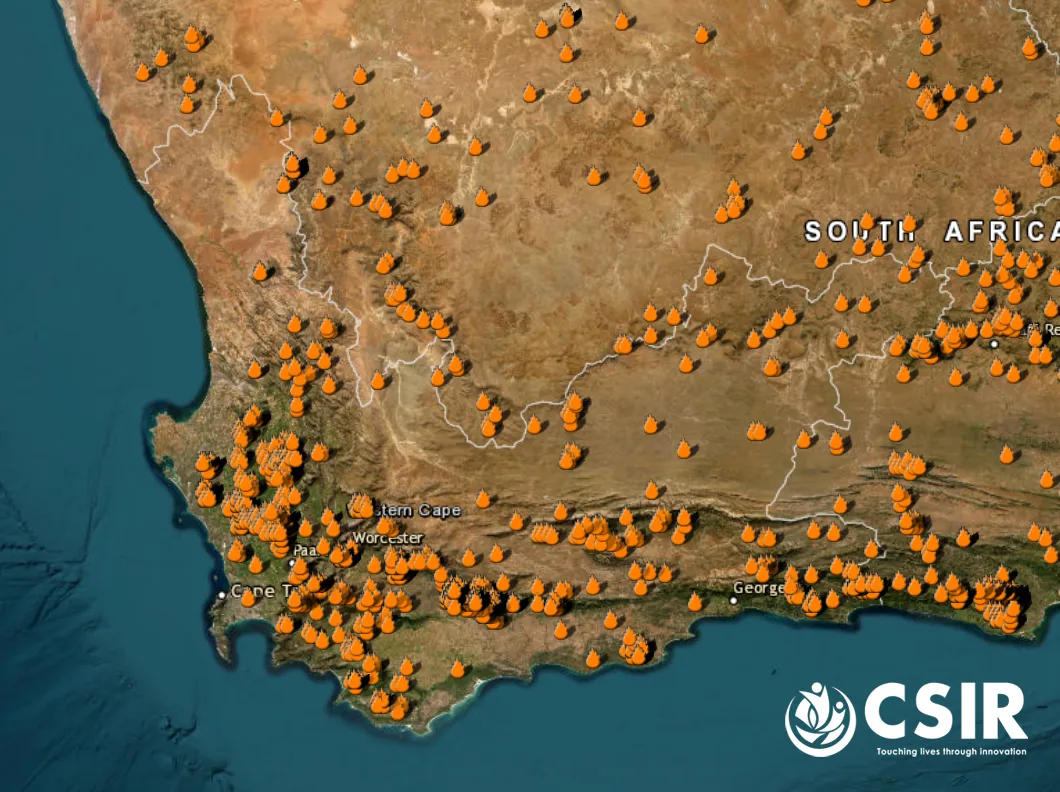
“The CSIR’s open access information tools, such as the Advanced Fire Information System (AFIS), GreenBook and the Settlement-Mesozone Geo-Frame, assisted in contributing expertise on fire data generation and management, which was based on the dashboard development from the GreenBook,” says CSIR principal researcher Dr Sarah Davies.
The dashboard shows the province’s socioeconomic context and vulnerability, together with biodiversity and wildfire risk data. This provides information to managers and decision-makers who need to make informed decisions ahead of time to preserve lives and livelihoods and promote more biodiverse and resilient landscapes, as well as respond to wildfires when they occur and coordinate recovery actions after wildfires have occurred.
Worldwide, Mediterranean climate regions have hot, dry summers and wet winters that fuel the spread of wildfires, putting Mediterranean ecosystems at risk. At the same time, these ecosystems depend on fire to support the reproduction of fire-dependent species such as proteas, but also to maintain open habitats for human uses such as agriculture. To increase the Western Cape’s resilience to wildfires, a “Socioeconomic Vulnerability to Wildfire Risk” module has been developed to address the need for predictions and early warning, as well as management of longer-term trends in fuel loads. This information will be useful for disaster management, biodiversity management, invasive alien species management and climate change adaptation.
“Fynbos is a fire-dependent ecosystem, but too-frequent fires can also be problematic for some fynbos plants, wetlands and peat ecosystems. This important biodiversity stands to benefit from being protected with the use of the Mediterranean Fire Risk Information Management System,” says Davies. By using the information system, managers will be able to identify areas with high fuel loads, such as areas invaded by introduced trees, and ensure that they are cleared prior to the wildfire season.
The Mediterranean Fire Risk Information Management System was made possible through a research grant from Resilient Cities Catalyst in the USA and was a collaboration between the CSIR and CapeNature in South Africa and the Centre for Ecological Research and Forestry Applications in Spain, with support from the Western Cape Government, the Catalan Government and the Mediterranean Climate Action Partnership. The inputs of the multi-country stakeholders were analysed to inform a situation analysis from which the system design and pilot modules arose.
“In the process, we formed a strong partnership with CapeNature and the Centre for Ecological Research and Forestry Applications and the Catalan Government in Spain,” she says. “We came together to discuss wildfire risks, socioeconomic and biodiversity information needs and resources in the two regions and how they could be harnessed to create a system that incorporates the respective countries’ specific wildfire risk information needs.”
Davies adds that they have detected trends in South Africa from the GreenBook that may affect the frequency, intensity and negative impacts of wildfires. “Already, wildfire concerns are on the rise for arid and sparsely vegetated parts of South Africa. Ongoing climate change is expected to make these areas hotter, drier and the increased carbon dioxide in the atmosphere stimulates some plants to grow faster, which may fuel damaging wildfires.”
The new system will work alongside existing near-real-time fire management systems but will extend its functionality by providing longer-term views to enable proactive planning and responses to evolving fire risks. The team hopes that the system can be expanded to cover additional Mediterranean areas and unlock greater recognition of wildfire management in Mediterranean regions.
“The more we studied existing information systems, we realised that the new system could be integrated into an existing wildfire information system because the architecture already exists; the already available global data needs to be geared towards Mediterranean fire management,” says Davies. The next phase of the project will be of a more practical nature and will ascertain future collaboration with the European Forest Fire Information System and the Global Wildfire Information System.
Published 26 March 2026