From the south to the north, contractors and customers on the continent expect solar photovoltaic (PV) modules, or solar panels, to perform for 25 to 30 years on rooftops and farms. Indeed, there are both legal and financial consequences for everyone involved if Africa’s booming solar PV installations were to prove unsafe, unreliable or short-lived.
In response to this rising demand for quality local products, the CSIR has allied with Egypt’s Helwan University to help African manufacturers improve solar panel system reliability. The partnership will help reduce the reliance on imports as businesses and governments expand Africa’s solar energy footprint.
“The CSIR is strong on the photovoltaic (PV) module side, and the Egyptians are very good in the inverter space, so we are bringing the two capabilities together,” says Dr Kittessa Roro, a lead researcher at the CSIR Energy Research Centre.
The South African work packages, which are jointly funded by the CSIR and South Africa’s Technology Innovation Agency, will thus help manufacturers benchmark locally made solar PV modules for quality and reliability, as well as improve performance.
CSIR senior researcher Manjunath Basappa Ayanna says the CSIR is home to the only facility in southern Africa to offer the full suite of internationally recognised solar PV module quality and performance tests.
“The CSIR’s Solar PV Quality and Reliability Laboratory is an ISO 17025 accredited facility offering test services to plant owners, project developers, engineering, construction, operation and maintenance companies since 2021,” he says.
Technicians at the lab begin with a visual inspection to look for cracks, broken glass, moisture damage or any signs of damage due to mishandling of the solar PV panel during transportation, which could impact the installation or performance.
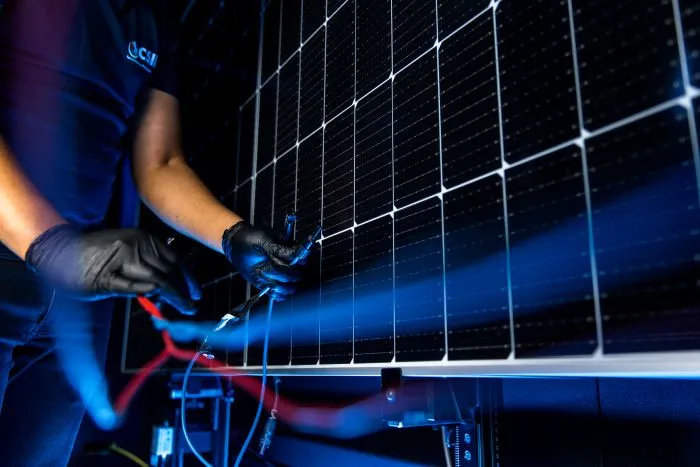
Next comes the power output measurement, where the panel is exposed to a burst of bright, artificial “sun” to ensure it matches the manufacturer’s labelled specifications. “We have a pulsating lamp that flashes for less than a second, and then we can determine all the electrical parameters from there – your power, voltage and current,” says lab technologist Hlaluku Wisani Mkasi.
Ayanna explains that these power measurements are essential for quality assurance and stress testing, as they set performance baselines, verify compliance, detect power loss from stress and ensure reliability as per international standards.
From there, the panel is placed in a dark room, powered up and then photographed using an electroluminescence camera that captures infrared light emitted by individual cells. The result looks much like an X‑ray image, revealing cracks and defects hidden from the naked eye, as well as dead zones where no electricity is being produced. This method detects approximately 90% of defects that could affect performance.
The panel is then submerged in a water tank for an electrical safety test.
“Solar panels are generally designed to be safe to conduct routine maintenance, like manual cleaning, without switching off the system. However, if there’s a power leakage, wiping the panels can create an electrical path to your body that may result in a serious electrical shock,” explains Mkasi. Power leakages lead to maintenance safety risks, he says, but they also lower the panel’s performance, which risks investments made in a new solar PV system development.

After the non-destructive tests, Mkasi’s team exposes the panel to accelerated ageing and stress testing in accordance with the international gold standard, IEC 61215.
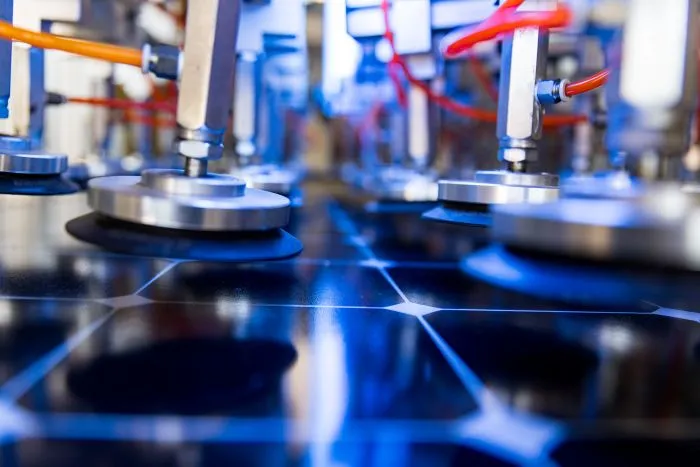
For example, technicians use a special machine to check if the panel can withstand intense vibrations, simulating possible damage due to transportation, installation, handling and strong winds during operation. It also determines resistance to static pressures or loads such as snow.
The panel is also baked for 1 000 hours (42 days) at a temperature of 85°C and at 85% humidity to simulate decades of harsh African weather conditions. If the panel loses more than 5% of its rated power, it fails.
Mkasi says the CSIR team has seen a wide range of problems over the years, both in the lab and in the field: panels that only produce 30% of their claimed power output (known technically as rated nameplate power), others with cracked cells, and some with dangerous electrical faults.
Regardless of whether panel samples pass or fail the tests on offer at the CSIR, his team issues a comprehensive technical report. Importantly, these reports can be used in court proceedings, such as when project developers face liability claims when solar panels fail or underperform.
Reliability testing is not only about preventing sub-standard products from flooding the market, says Mkasi, but also about protecting long-term system performance, reducing technical and financial risk and giving investors confidence in large-scale solar projects.
Ayanna adds that the partnership with Egypt’s experts on inverter reliability testing will expand confidence in African solar system products even further across the continent.
Helwan University has established a national inverter reliability and standards testing platform in Egypt, and its experts have developed the hardware and software for a prototype three-phase inverter.
“Helwan University has developed a new platform for the first time in Egypt to perform the necessary standard tests of the well-known IEC and IEEE standards on a PV three-phase inverter system adopted in the residential sector,” says Ayanna. “The inverter test platform is intended to reduce performance and safety risks and to demonstrate long-term quality and reliability.”
According to the agreement signed between the university and the CSIR, Egypt also brings a broad ecosystem of industrial, regulatory and business support organisations to the partnership, which will help accelerate market adoption and uptake of new local products.
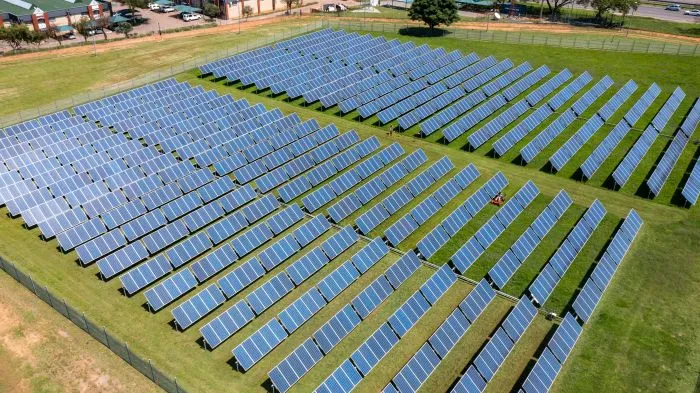
Roro, Ayanna and Mkasi say that better local solar system products and quality regulations are good for manufacturers, good for customers, good for the environment and good for energy security all over Africa.
More information about our research, facilities and services: https://www.csir.co.za/what-we-do/natural-environment/energy/energy-supply-and-demand
Published 11 February 2026