Bystanders and motorists rely on driver assistance technology, road restraint systems and other safety features to reduce harm in case of a crash, but the road death toll is already climbing in 2026. CSIR researchers say the problem can be tackled scientifically from all angles.
As schools re-opened for the 2026 academic year, South Africans awoke to devastating news: 14 learners were killed after a scholar transport vehicle they were travelling in crashed into an oncoming truck in Vanderbijlpark, Gauteng. The driver of the scholar transport vehicle had tried to overtake multiple other vehicles by moving into the oncoming lane.
CSIR transport safety scientist Khangwelo Muronga says harm from crashes like these could be minimised by fitting public transport vehicles with an Advanced Driver Assistance Systems (ADAS), and by strengthening the rigour of driving licence testing and professional driver permit processes. Investing in more forgiving road designs that help guide driver behaviour and reduce the risk of collisions would also be valuable.

But any intervention should be scientifically tested and validated to ensure that standards are met and that products work within South Africa’s unique road conditions and driver behaviours.
Muronga leads a team of researchers at the CSIR Transport Safety Laboratory, which shares independent, scientific findings with authorities like the South African National Roads Agency (SANRAL) and the Road Traffic Management Corporation (RTMC), as well as the Automobile Association of South Africa.
The lab features a drive simulator and a test vehicle, which help researchers design real-world experiments to test driver assistance technologies, road restraints, weather conditions and the impact of accidents on passengers, drivers and bystanders. Real-world data, in turn, feeds back into simulations, which can be used to design better driving regulations, technologies, manufacturing standards and driver training programmes, and to recreate accident scenes for legal or insurance claims.
“Our goal at the CSIR Transport Safety Lab is to do something about the stats reported every year,” says Muronga, in reference to the annual death toll from road crashes. In 2025, South Africa recorded over 11 000 road fatalities, resulting from just under 10 000 crashes.
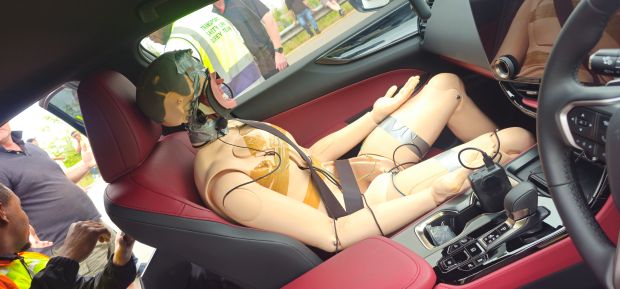
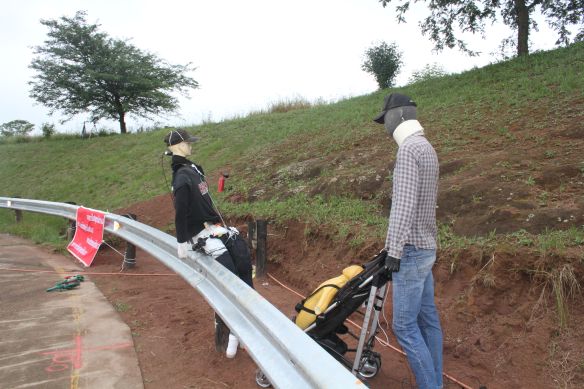
A crash test dummy is placed in a passenger seat for testing, while others are set up along a road barrier to mimic pedestrian behaviour. The University of KwaZulu-Natal and Accident Specialists brought the CSIR on board to see how well South Africa’s standard road barriers protect bystanders and passengers. The restraint systems contained the vehicle at the speed of impact as per the standard specification.
“We can reduce those numbers, and it helps to look scientifically at what really causes these fatalities.”
In a 2024 study, the University of KwaZulu-Natal and local company Accident Specialists brought the CSIR on board to see how well South Africa’s standard road restraint systems protect bystanders, especially children, during a crash.
“We had a child-sized crash test dummy sitting inside the vehicle, and we had some adult and child dummies standing next to the road restraint,” he says, adding that South African pedestrians often sit on guardrails on the side of the road.
“We wanted to see what happens to the child in the car in the event of an impact, and whether the crash would be fatal for pedestrians. We also checked if the airbags in the vehicle would deploy or fail, and whether the barriers themselves are safe or would contribute to injuries.”
They found that the barriers worked well only when manufactured strictly according to the standard. “There is a very thin line between a barrier being effective and not; it's not something that allows for any margin of error,” says Muronga.
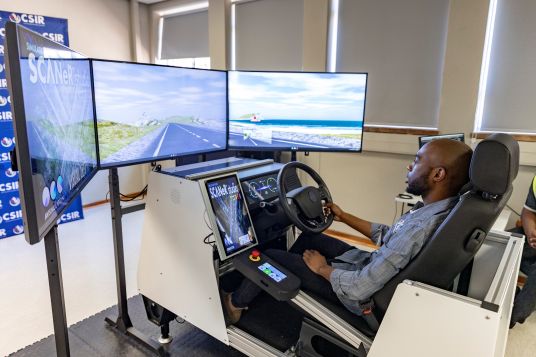
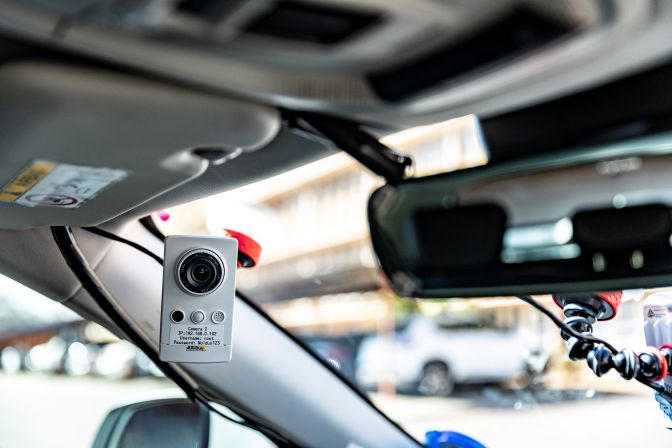
The CSIR Transport Safety Laboratory features a driving simulator (left) and a test vehicle (right), which help researchers design real-world experiments to test driver assistance technologies, road restraints, weather conditions and the impact of accidents on passengers, drivers and bystanders. Real-world data, in turn, feeds back into simulations, which can be used to design better driving regulations, technologies, manufacturing standards and driver training programmes, and to recreate accident scenes for legal or insurance claims.
While formal recommendations have not yet been made to SANRAL or the RTMC, the CSIR is engaged in ongoing work with these entities to implement performance-based road restraint systems in South Africa.
In another area of research, Muronga’s team was again invited by the University of KwaZulu-Natal and Accident Specialists to look at how well seatbelts and automatic braking systems perform in existing vehicles or vehicles that will soon enter the market. For lower speed tests, the team used inflatable animal models to simulate unexpected wildlife crossing the road, such as during a safari at the Kruger National Park. These tests replicate real-world driving conditions and assess whether the vehicle’s ADAS detects the obstacle and applies the brakes in time.
Muronga says that for these and other tests, he has been particularly impressed by the performance of vehicles from Chinese manufacturers.
In general, the CSIR’s research recommendations are shared formally with authorities, as well as informally with manufacturers and other stakeholders through platforms like the Southern African Transport Conference.
Muronga adds that the CSIR is helping to strengthen the evidence base needed to ensure that cars sold in South Africa comply with safety standards.
But even if vehicles and roads are as safe as scientifically possible, human error remains a critical factor. This is true, for example, for the 22-year-old now facing charges of reckless and negligent driving for his role in the fatal Vanderbijlpark scholar transport accident.
“We have also been testing novice versus experienced drivers, and we are looking at how South Africa’s driving schools are teaching people to drive,” says Muronga.
His team is using insights from the driving simulator and test vehicle to better understand gaps in driver training and the standards of driving schools. “We want to advise on the kind of training driving schools should be doing beyond just the current K53 exam.”
Broadly, he says, South Africa needs transport safety solutions that are research-based and aligned with road safety standards issued by the World Health Organization, and which comply with the United Nations Decade of Action.
He also invites authorities and vehicle manufacturers to expand collaborations with the CSIR to help bring down South Africa’s road death toll. “The CSIR Transport Safety Laboratory is a state-of-the-art facility that supports national efforts to reduce road fatalities and improve transport infrastructure through scientific research, data-driven solutions and advanced technologies.”
More information about our research, facilities and services: https://www.csir.co.za/what-we-do/mobility-and-logistics/transport-safety
Published 02 March 2026