A local biotechnology firm announced that it will produce a key molecule used internationally to grow meat products more sustainably. This follows the successful industrial scale‑up of the molecule’s production process in CSIR bioreactors, with funding from the Department of Science, Technology and Innovation and the Technology Innovation Agency, under the Biomanufacturing Industry Development Programme.
Immobazyme, a South African start-up, originally approached the CSIR with a bacterial strain they had genetically modified to produce fibroblast growth factor 2 (FGF‑2). This protein gives the signal to mammalian cells to multiply and proliferate, so it is essential for meat grown in a laboratory (commonly called lab-grown meat).

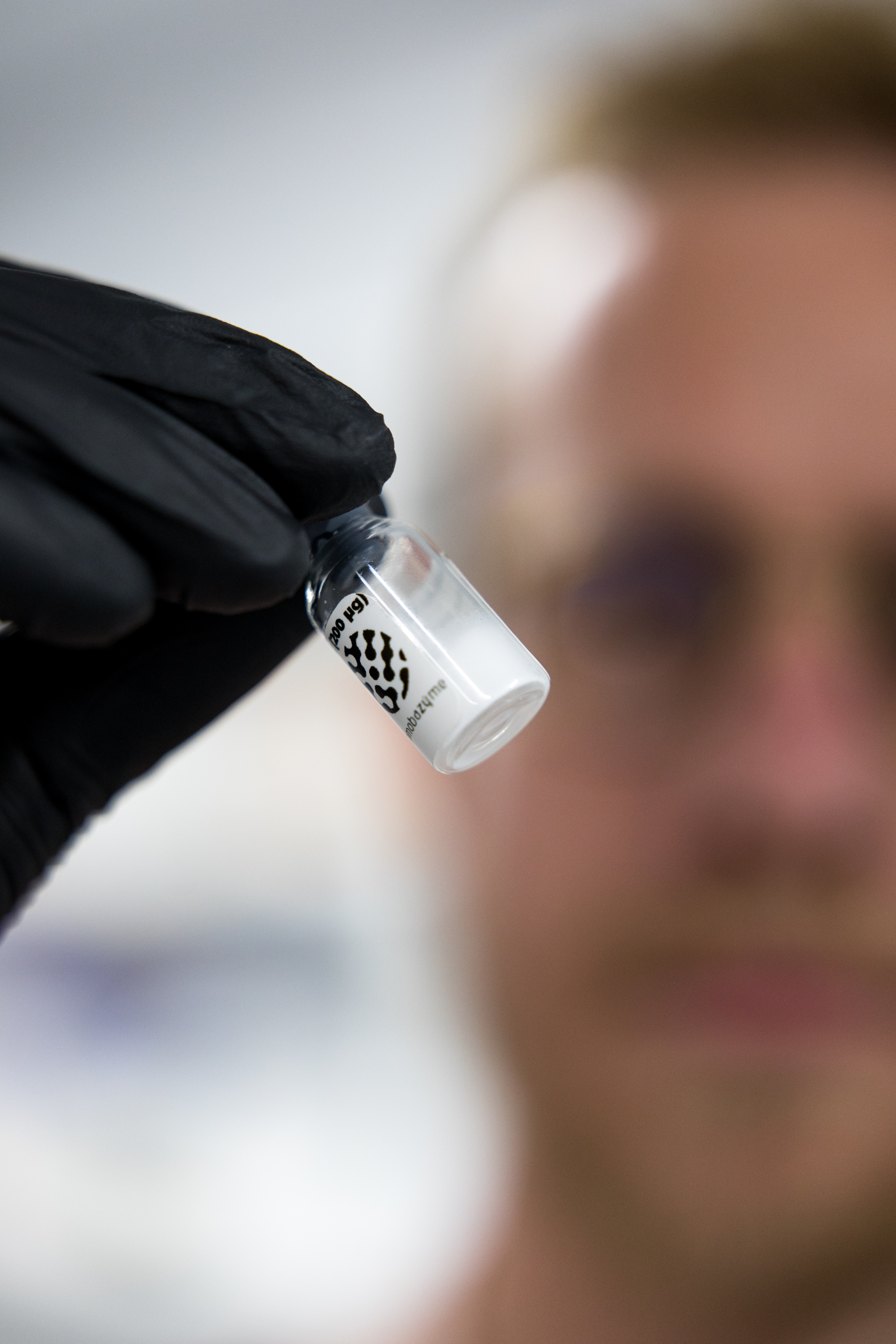

Immobazyme, a local biotechnology start-up, approached the CSIR with a bacterial strain (left) they had genetically modified to produce a commercial protein called fibroblast growth factor 2 (FGF‑2). This protein gives the signal to mammalian cells to multiply and proliferate, so it is essential for the lab-grown meat industry (Right)
“Companies specialising in cell-cultivated meat take a cell from a cow or a fish or a chicken. They take it to the laboratory and then they make that one cell become many cells and eventually those many cells become a food product,” says Nick Enslin, Chief Commercial Officer and co-founder of Immobazyme.
Growth factors such as FGF‑2 are added to guide and sustain the meat growth process, but these molecules have traditionally been very expensive to produce and are therefore costly for lab-grown meat companies.
Dr Veshara Ramdas, a biotechnology expert at the CSIR, says that when the Immobazyme team shared the potential value of FGF-2 for the global cultivated meat industry, her team saw an excellent business case to scale up their production process at the CSIR Biomanufacturing Industry Development Centre (BIDC).
“They brought the technology for us to look at development and scalability,” says Ramdas, adding that the CSIR’s task was to develop a cost-effective and efficient process using precision microbiology and bioreactors.


CSIR researchers have created market-ready protective microcapsules, which can be used as a powder (left), in ointments (middle) or as a film lining for plasters (right). The formulation consists of calcium peroxide encapsulated within a coating of natural polymers. When applied to a wound, oxygen releases slowly to boost cell growth and repair, while the calcium component interacts with the polymer coating to form a gel; this enables the material to congeal nicely on the wound
First, microbiologists establish sterile and stable conditions and ensure that only Immobazyme’s genetically modified E. coli is growing in the bacterial culture, as well as the protein of interest. The culture starts in a petri dish, grows further in a flask with ideal nutrients and is then transferred to large drums known as bioreactors. Bioreactors are precisely controlled in terms of temperature, nutrients and other parameters to ensure that the E. coli efficiently produces FGF-2 on a large scale.
“When we harvest the bioreactor, that whole broth then goes through a separation process,” says Ramdas. The liquid component is separated from the E. coli biomass.
Next, the FGF-2 protein must be cleanly extracted from the E.coli and purified. “Our product is based intracellularly, so we have to pop those cells open or break them open, in a process of mechanical disruption,” she says.
The broken E. coli cells are then removed from the mixture through centrifugation, a high-speed spinning process that forces heavy cell material to sink to the bottom of a container while the target protein remains in a clear liquid at the top.
“This clarified lysate goes through a purification process,” says Ramdas. The result is a pure protein powder of FGF-2 ready for cell culture in the lab-grown meat industry.
“For the first time in South Africa, we were able to demonstrate a process for this growth factor at a 50-litre bioreactor scale,” she says. “It is a huge achievement for the CSIR and this opens doors to other novel and unique technologies to localise, particularly fibroblast growth factors and others such as insulin growth factors.”
Enslin says the industrial insight gained through the collaboration with the CSIR is invaluable for its business going forward and the company also benefitted immensely from training provided by Ramdas and her fellow CSIR colleagues.
“The BIDC is an incredible facility; it is a world-class facility,” he says. “But I would almost say beyond the facility itself, the equipment and the machinery, there was this flow of ideas; it was a collaborative effort.”
He says the future holds larger-scale manufacturing for FGF-2, as well as other proteins and products they have in the pipeline. As a small firm, they will continue using the large facilities at the CSIR in Pretoria to bolster their own production.


The CSIR’s biotechnology facilities were key to the production of fibroblast growth factor 2 for the local start-up Immobazyme. Microbiologists establish sterile and stable conditions and ensure that only Immobazyme’s genetically modified E. coli is growing in the bacterial culture before transferring the culture to large bioreactors
“The fact that Immobazyme took a unique and new construct that they had developed and produced this FGF-2 in a cost-effective manner puts them in a competitive position compared to what is available internationally,” says Ramdas.
“At the end of the day, we got commercially viable product through this relationship, which is really cool to see,” says Enslin.
More information about our research, facilities and services: https://www.csir.co.za/what-we-do/chemicals-and-materials/biomanufacturing
Published 10 March 2026