CSIR researchers have created market-ready protective microcapsules containing a novel wound-healing formulation. Studies confirm that the microcapsules, which can be used as a powder, in ointments or as a film lining for plasters, allow for a sustained, slow release of oxygen that promotes cell growth and repair.
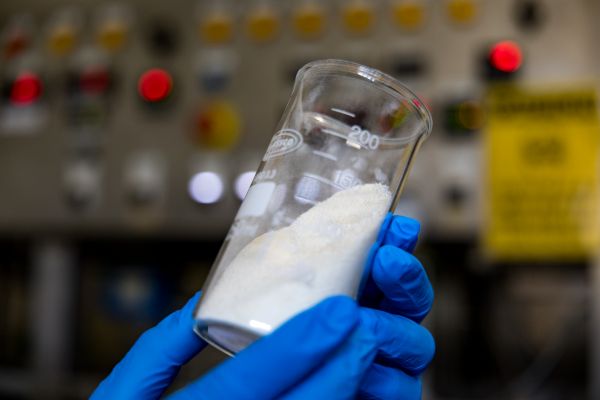
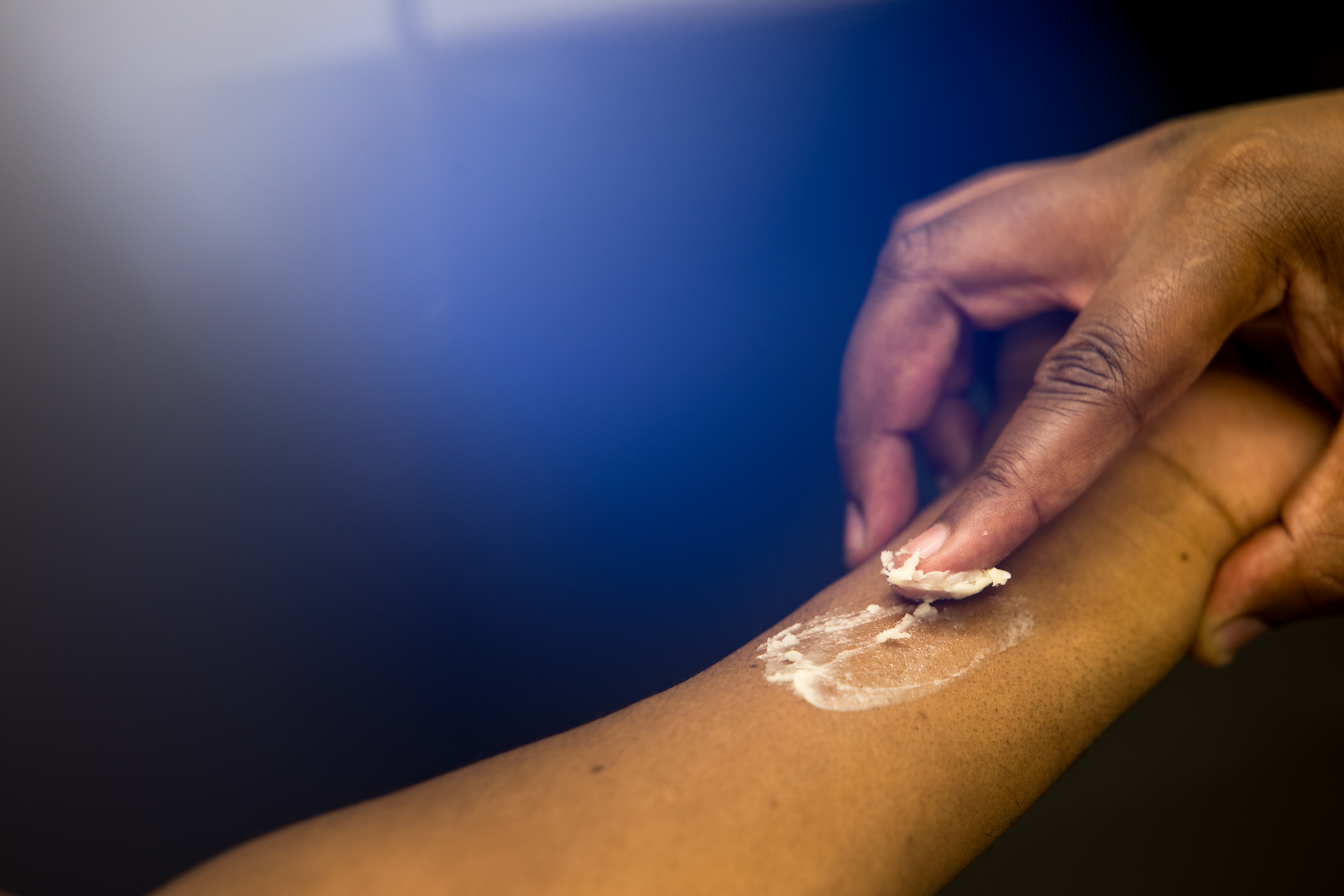
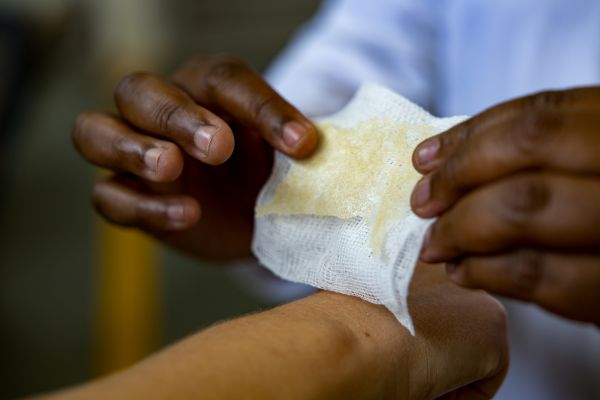
CSIR researchers have created market-ready protective microcapsules, which can be used as a powder (left), in ointments (middle) or as a film lining for plasters (right). The formulation consists of calcium peroxide encapsulated within a coating of natural polymers. When applied to a wound, oxygen releases slowly to boost cell growth and repair, while the calcium component interacts with the polymer coating to form a gel; this enables the material to congeal nicely on the wound.
Dr Lerato Hlekelele, a material scientist at the CSIR, says it is well documented that chronic or severe wounds, such as diabetic ulcers, heal slower due to a lack of oxygen at the wound site. This is often caused by impaired circulation, leading to hypoxemia (low blood oxygen).
He says his team began investigating polymers that could supply oxygen directly to injured skin after seeing the devastating effect that severe wounds had on a former colleague. “A gentleman who used to work here with us on polymer processing was diabetic and both of his legs had to be amputated because of wounds that wouldn’t heal,” he says.
“If the product we have now was well-known and available in the market, I’d like to believe that perhaps this gentleman may still have had his legs.”
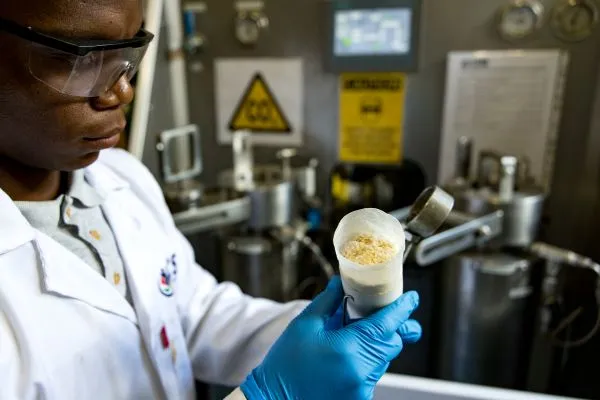
Hlekelele’s team pinpointed calcium peroxide as an ideal source of oxygen early on, but the problem was that it would react very quickly with moisture in the wound, releasing oxygen too fast. Their slow-release solution, developed in just 18 months, was to encapsulate this sensitive ingredient at the microscopic level using a CSIR-patented method that relies on supercritical carbon dioxide (CO2).
Natural, food-grade biopolymers common to many skin products are used to encapsulate the calcium peroxide, forming a protective barrier that prevents oxygen from being released too quickly.
"The process works by first dissolving supercritical carbon dioxide into a mixture of active ingredients and coating materials,” says the CSIR’s Dr Philip Labuschagne, the man behind the patent. The solution is then rapidly sprayed through a nozzle, releasing the carbon dioxide for later re-use and producing a fine powder of microcapsules (the active ingredient, encapsulated within the coating material).
“Once the oxygen is released when applied to a wound, the calcium part of the calcium peroxide interacts with the polymer coating to form a gel, which enables the material to congeal nicely on the wound,” says Hlekelele. “So, we have killed two birds with one stone, so to speak, in that this product has the dual action of oxygenation and gelation.”
Microbial testing further showed that the combination of these ingredients prevents the growth of bacteria and fungi, which in turn prevents a potentially deadly antibiotic-resistant biofilm forming on the wound.
Tests at the CSIR’s bioengineering facility also confirmed that the powder stimulates wound closure and does not damage skin cells. Scientists compared the powder with other wound-healing products on the market, as well as a control where no product was applied.

“We specifically tested the product on human dermal fibroblast cells that were donated to the CSIR. These cells make up a key layer of skin that produces collagen and elastin, which help with structure and elasticity,” explains Hlekelele. “They are essential for wound closure because they migrate to the injury site, proliferate and synthesise new molecules for tissue repair.”
In the lab, researchers grew a consistent layer of cells and then created a scratch, leaving a gap that mimics a physical wound.
“We then monitored how effectively the cells migrated and proliferated to bridge that gap,” says Hlekelele. “By measuring the rate at which the space closes, we can quantify exactly how much our technology speeds up the natural healing process.”
With microencapsulation, safety and efficacy confirmed, the next task was to ensure that local companies interested in commercialising the product would have something customers would readily buy at their local dispensary.
The team’s market research showed that while the synthesised powder product would appeal to some patients, others may prefer to apply a salve or a plaster.
“We have now designed three ways to apply our material,” says Hlekelele. “It can be used directly as a powder, which would, for instance, work well as a dry product for soldiers or others working in remote environments. But we have also incorporated it into an ointment that applies very smoothly. Lastly, we used the CSIR’s compression moulding facility to create a film that can be placed on the wound underneath a plaster.”

He says the CSIR calls on small but established local pharmaceutical businesses to formally express their interest in licencing these three products. “The CSIR would then assist the business to establish and scale up its manufacturing at our Supercritical CO2 Microencapsulation facility, which is the only pilot facility of its kind in Africa.”
The facility was established to support local health and cosmetic industries, thanks to an investment of R25.9 million by the Department of Science, Technology and Innovation.
Speaking at the facility’s launch in 2025, CSIR Chief Executive Officer, Dr Thulani Dlamini, said that the facility “opens the door for local researchers, entrepreneurs and manufacturers to test, refine and scale their innovations right here at home, reducing reliance on international facilities and accelerating the path from laboratory to market.”
One such innovation already on the market is a microencapsulated probiotic sold by local company Velobiotics.
“Being part of the CSIR team assisting with Velobiotics’ product and seeing the response, seeing that these products are helping people, makes me want to see this wound-healing technology out there as well.”
More information about our research, facilities and services:
https://www.csir.co.za/what-we-do/chemicals-and-materials/nanostructures-and-advanced-materials
Published 26 February 2026