South Africa's mining sector is recognising climate action as a strategic imperative, according to the results of a study led by the CSIR.
Published in an Elsevier journal, the paper provides an exclusive view into South Africa’s top 13 Johannesburg Stock Exchange (JSE)-listed mining companies’ sustainability efforts and priorities towards the 17 Sustainable Development Goals (SDGs), based on their 2020 to 2023 annual reports. The study ranked Climate Action (SDG 13), followed by Responsible Consumption and Production (SDG 12), Affordability and Clean Energy (SDG 7), Decent Work and Economic Growth (SDG 8) and SDG Reduced Inequalities (SDG 10) as the top five SDGs prioritised by the companies.
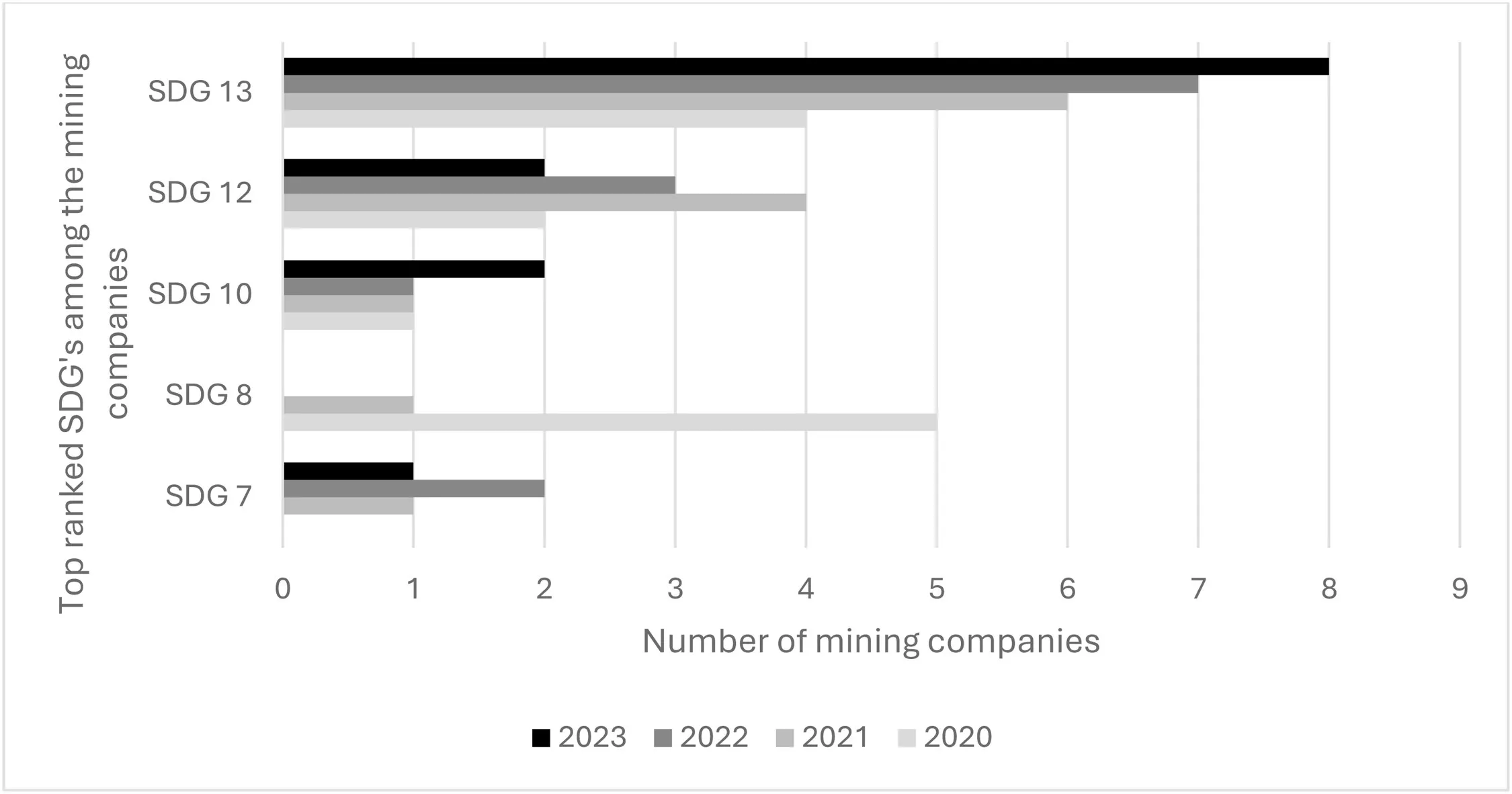
With funding received from the Department of Mineral and Petroleum Resources, the project commenced in 2024 and is managed by the Council for Geoscience. The research study arose as an off-shoot of earlier research led by the CSIR’s mining research cluster in which results indicated that the prioritisation of the 17 SDGs among the top 13 mining companies fluctuated during the three years under review.
This sequential ranking of the top five SDGs is indicative of their relative priority to the top 13 JSE-listed mining companies hold significant market weight and produce various platinum group metals, coal, minerals and gold commodities, with international trading activities involving platinum group metals, chrome and manganese, alongside record-high commodity prices.
“With the use of the text-mining tool SDG Mapper, we were able to evaluate the South African mining sector’s prioritisation of the SDGs,” says CSIR senior researcher Dr Lorren Haywood. This free online tool quantified the direct and indirect references and disclosures to all 17 SDGs by using natural language processing and a curated set of keywords.
“We placed each company’s annual report through the SDG Mapper, where it scanned the documents and detected SDG-related content. The results generated are percentages reflecting how often each SDG is directly or indirectly referred to, based on the predetermined keywords,” Haywood says. Additional insights have uncovered an increase in direct and indirect references to the SDGs in the companies’ annual reports over the past few years.
In identifying growth trends between 2020 and 2023, the research team’s analysis revealed high levels of SDG references in 2020 for SDGs 8 (Decent Work and Economic Growth) and 12 (Responsible Consumption and Production). SDGs 12 (Responsible Consumption and Production) and 13 (Climate Action) dominated in 2021. In 2022, SDGs 8 (Decent Work and Economic Growth) and 13 (Climate Action) dominated, while SDG 13 (Climate Action) took the lead in 2023, followed by SDGs 8 (Decent Work and Economic Growth), 7 (Affordable and Clean Energy) and 12 (Responsible Consumption and Production). Collectively, these patterns paint a picture of the average percentage disclosure of each SDG in the companies’ annual reports.
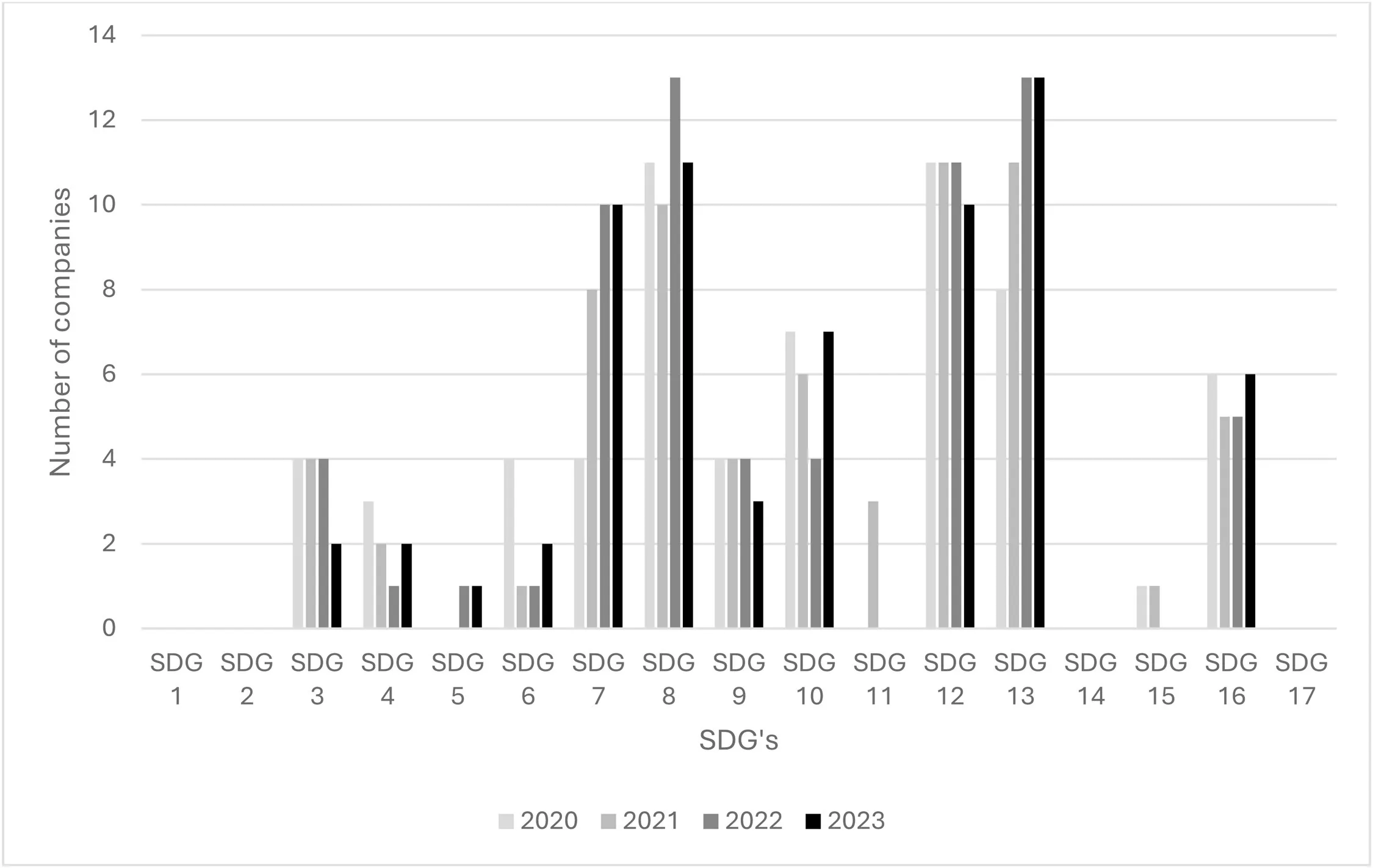
Notably, SDG 13 (Climate Action) has shown a consistent year-on-year increase in references, while SDGs 7 (Affordable and Clean Energy), 8 (Decent Work and Economic Growth) and 12 (Responsible Consumption and Production) have experienced fluctuations, with a slight decline in priority over the four-year period.
The social SDGs, such as SDG 3 (Good Health and Well-Being), SDG 5 (Gender Equality) and SDG 16 (Peace, Justice and Strong Institutions), were identified as significant priorities by some of the mining companies included in the analysis.
As the most referenced SDG, Climate Action is a priority for mining companies because climate change directly affects their operational viability, regulatory compliance, financial performance and social licence to operate. Its prioritisation enables the sector to maintain credibility as a supplier of critical minerals for the global energy transition, demonstrating that mineral production growth is aligned with decarbonisation and long-term resilience.
Absent from the top-referenced SDGs for any of the mining companies are No Poverty (SDG 1), Zero Hunger (SDG 2), Life Below Water (SDG 14) and Partnerships for the Goals (SDG 17). This suggests that these goals are not currently considered top priorities or material risks in terms of environmental, social and governance disclosures, may not always be framed explicitly in SDG language or may not be highlighted in non-financial reporting by mining companies in South Africa at present.
“While the SDG Mapper text tool does not assess the quality or materiality of the disclosures, it provides a replicable and objective means to benchmark the relative prominence of each SDG across reports,” Haywood says.
Historically, integrating sustainability into the mining sector has been challenging. Increasingly, however, companies are integrating SDGs into their strategic reporting, signalling that such disclosures are important and a priority for the organisation. This can assist in addressing the global urgency to attain the 17 SDGs by 2030 and in meeting the triple bottom line of people, planet and profit.