Johannesburg, South Africa – The Council for Scientific and Industrial Research (CSIR), through the Mandela Mining Precinct's Advanced Orebody Knowledge Programme, has successfully completed an underground proof-of-concept field test of an innovative acoustic rock-sounding application at Harmony Gold's Mponeng Mine. The field trial was concluded on 16 July 2026 in collaboration with the mine's Rock Engineering team and marks an important step towards the digitalisation of underground workplace examination and fall-of-ground risk management practices.
Barring and rock sounding remain critical activities used by mineworkers to identify and remove potentially loose or hazardous rock. While experienced personnel are highly skilled in recognising sounding responses, interpretation can vary between individuals and may be influenced by environmental conditions such as underground noise and fatigue. The acoustic rock-sounding application aims to support existing workplace examination practices by providing a consistent, data-driven assessment of acoustic responses generated when rock is struck during sounding activities.
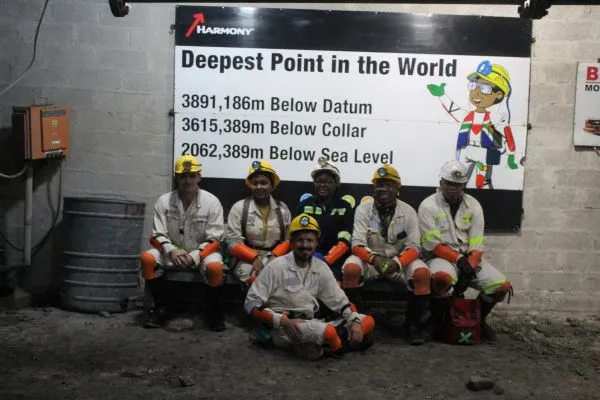
Developed through a collaborative research initiative between the CSIR and Peralex Electronics, the application uses advanced acoustic signal processing and machine-learning techniques to analyse rock-sounding responses and classify them according to characteristics associated with solid or potentially loose ground conditions. The technology is intended to complement, rather than replace, the expertise and judgement of trained underground personnel.
The Mponeng field test successfully demonstrated the technical feasibility of the concept under real mining conditions. Core application functions, including underground audio recording, acoustic classification, confidence scoring, event logging, offline operation and data export, were successfully evaluated. The trial also provided valuable practical insights that will guide future development and optimisation of the technology.
"The Mponeng field test provided valuable real-world insight into how the acoustic rock-sounding application performs in an underground mining environment. It confirmed the technical feasibility of the concept while also identifying the practical refinements required before operational deployment," said Heinrich Greeff, CSIR Project Lead.
Beyond assisting with current workplace examination activities, the technology offers significant future potential. By digitally capturing and storing acoustic strike data, the system establishes a foundation for trend analysis, hazard tracking and future integration with spatially referenced ground control and risk management systems. The long-term vision is to develop a platform capable of supporting proactive ground control decisions, workplace examinations and rock engineering reviews through enhanced hazard intelligence.
Falls of ground remain one of the most critical safety risks in deep-level mining. The acoustic rock-sounding application contributes to fall-of-ground risk management by supporting:
- more consistent interpretation of acoustic rock responses;
- improved digital recording of barring and sounding activity;
- future auditing of where and how sounding has been conducted;
- development of datasets that can support improved model training and future hazard intelligence; and
- potential future integration with spatial positioning systems and workplace hazard maps.
As the technology matures, the longer-term vision is to move from individual acoustic classifications towards spatially referenced hazard information that can support rock engineering review, shift handovers, workplace examination and proactive ground control decisions.
The next phase aims to transition the system from a proof-of-concept mobile application to a controlled operational pilot. This will require continued collaboration among researchers, software developers, rock engineering practitioners, mine personnel and technology partners.
The next phase of the project will focus on structured underground validation, refinement of the classification models, optimisation of hardware configuration and preparation for controlled operational piloting. Continued collaboration between mining companies, researchers, software developers and technology partners will be essential to advancing the technology towards practical industry adoption.
Harmony Gold's participation in the field trial demonstrates the value of collaboration between industry and research institutions in developing innovative solutions that contribute to safer, more sustainable mining operations. The successful test at Mponeng Mine highlights the mining industry's ongoing commitment to leveraging technology to enhance safety and support continuous improvement in underground risk management.
Quote from Harmony Gold
"Innovation plays a critical role in our drive towards safer mining. The successful field test at Mponeng demonstrates the potential of digital technologies to strengthen workplace examinations and support informed ground control decisions. We are pleased to collaborate with the CSIR and other technology partners in exploring practical solutions that can contribute to improved underground safety."
ENDS
Issued by CSIR Strategic Communication
For media enquiries, contact:
Phetolo Phatsibi, Media Practitioner
Email: @email
Contact: 081 396 8871
About the CSIR
The CSIR, an entity of the Ministry of Science, Technology and Innovation, is one of the leading scientific and technology research, development and implementation organisations in Africa. Constituted by an Act of Parliament in 1945 as a science council, the CSIR undertakes directed and multidisciplinary research and technological innovation, as well as industrial and scientific development, to improve the quality of life of all South Africans. For more information, visit www.csir.co.za.
Follow us on social media
Twitter: @CSIR. Facebook: CSIRSouthAfrica. Instagram: CSIRSouthAfrica. LinkedIn: Council for Scientific and Industrial Research (CSIR). YouTube: CSIRNewMedia
About the Mandela Mining Precinct
The Mandela Mining Precinct is a public-private partnership between the Department of Science, Technology and Innovation and the Minerals Council South Africa, co-hosted by the Minerals Council South Africa and the CSIR. The Precinct supports collaborative research, development and innovation aimed at advancing the modernisation, safety, sustainability and competitiveness of the South African mining industry. Through its research programmes, the Mandela Mining Precinct brings together government, industry, science councils, universities and technology partners to develop and demonstrate practical solutions for mining-sector challenges, including safer underground operations, improved orebody knowledge, digitalisation and technology transfer.
Published 24 August 2026