Monday 28 September 2026
CSIR, NOAA, CSIRO, Columbia University and University of Washington set sail on Antarctica's unchartered winter waters
South African researchers, alongside several international counterparts, are ready to collect data from an autonomous ocean drone deployed from Bruny Island near Hobart, Tasmania, Australia, on 20 September 2026. The multi-institutional mission into the Southern Ocean around Antarctica is expected to close a critical winter data gap with observations that are needed for more accurate global climate models.
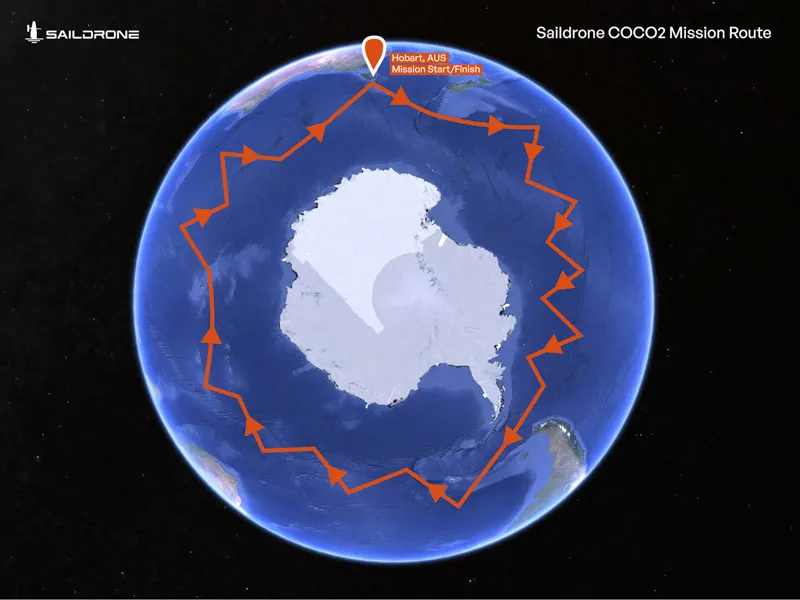
Dr Sandy Thomalla, CSIR chief researcher and head of the CSIR-hosted Southern Ocean Carbon-Climate Observatory (SOCCO) in South Africa, says the goal of the mission is to reduce uncertainty in global carbon budget estimates as part of a research project called Constraining Ocean Carbon with Optimised Observing (COCO2). The ocean drone will collect vital data on how the ocean absorbs and releases carbon dioxide, helping scientists better quantify the Southern Ocean’s role in regulating atmospheric carbon dioxide and the global carbon budget. The Hobart launch marks the first of four ocean drones, or uncrewed surface vehicles (USVs), that will set sail every quarter over the next five years. Each will circumnavigate Antarctica, measuring carbon dioxide, temperature, salinity, wind and other ocean-atmosphere conditions in one of the most important, yet least measured parts of the global climate system: the Southern Ocean.
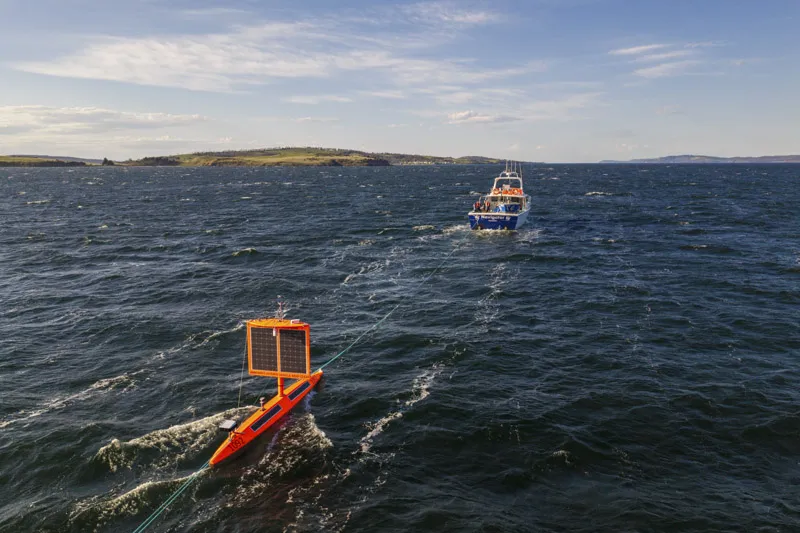
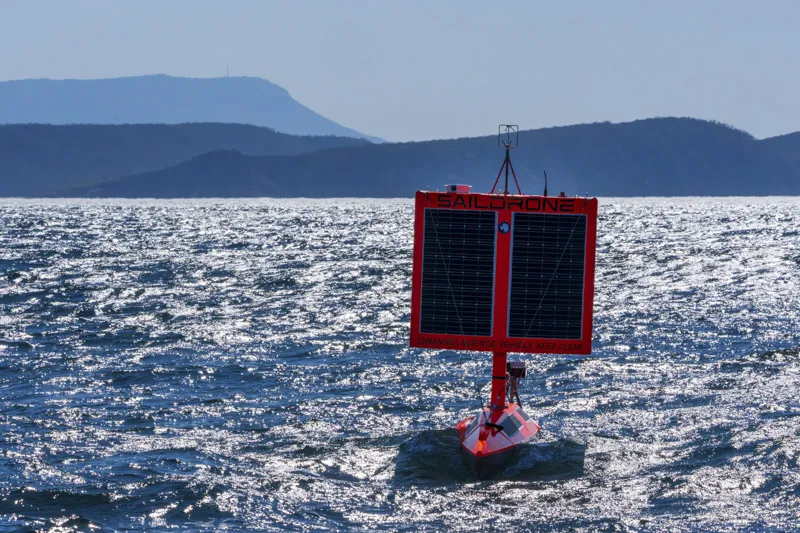
The USV deployments will be staggered by about three months, with one vessel launched at a time to ensure full sensor coverage of the Southern Ocean. A small boat towed the USV, made by Saildrone, out of the harbour, from where it is expected to travel more than 22 000 kilometers before returning to Hobart for sensor replacements and maintenance, after which it will set off again. The Saildrone USVs are small robotic sailing vessels powered by wind, while their onboard sensors are powered by the sun.
Each USV can also adjust its route to target regions that are most important for understanding the ocean carbon sink. Thomalla explains that the Southern Ocean takes up about 40% of the global ocean’s carbon dioxide uptake, as well as 75% of the heat generated by the excess carbon dioxide that remains in the atmosphere.
“The Southern Ocean is thus a disproportionately important ocean when it comes to buffering the impacts of climate change,” says Thomalla, who currently serves as the lead author on the Seventh Assessment Report of the Intergovernmental Panel on Climate Change (IPCC), one of the world’s most influential climate policy documents.
The COCO2 project brings together Australia’s national science agency, the Commonwealth Scientific and Industrial Research Organisation (CSIRO); the United States National Oceanic and Atmospheric Administration (NOAA); Columbia University in the United States; Saildrone, the company that builds and operates the autonomous ocean vehicles; the University of Washington in the United States; and South Africa’s CSIR, through SOCCO. The project is funded by Schmidt Sciences through its Virtual Institute for the Carbon Cycle.
Thomalla co-leads the project alongside three other top women scientists: Dr Adrienne Sutton (Principal Investigator, NOAA), Prof. Galen McKinley (Columbia University and Lamont-Doherty Earth Observatory) and Dr Elizabeth Shadwick (CSIRO and Australian Antarctic Program Partnership).
Thomalla says South Africa's participation in the COCO2 mission builds on nearly 15 years of continuous investment in ocean climate science through SOCCO by the Department of Science, Technology and Innovation (DSTI). "Sustained government support has helped build South African expertise in ocean carbon observations, robotics, modelling, satellite remote sensing, machine learning, data analysis and postgraduate training," she says.
For COCO2, CSIR scientists at SOCCO will use the data generated by these USVs to track exactly how carbon dioxide moves between the Southern Ocean and the atmosphere, capturing for example the rapid changes driven by individual storms that are often missed by conventional observations.
“We will look at the role of winds, waves and ocean currents to see how they drive changes in carbon dioxide fluxes (fluxes refer to carbon dioxide entering or leaving the water) regionally and seasonally,” says the CSIR’s Dr Sarah Nicholson, a lead SOCCO oceanographer on the project.
“The project will focus specifically on obtaining winter measurements, a critical blind-spot in existing observations; ships typically travel south only during summer, so because of a lack of ship access, scientists have hardly any observations of the Southern Ocean in winter,” says Nicholson. “There is therefore a seasonal bias we are trying to address.” Thomalla adds that the project will also help train the next generation of ocean climate scientists through student and early-career researcher exchanges.
"South Africa is a big player in the global climate science space and the observations we will collect in the Southern Ocean using these USVs will help close the biggest observational gap in carbon dioxide data during winter," says Thomalla. She adds that this work will feed into the annual Global Carbon Budget and, ultimately, into the science used by the IPCC.
“Thanks to ongoing CSIR and DSTI support, South Africa is not watching this work from the sidelines. We are at the table, helping to generate the data and tools the world needs to understand a changing climate.”
Media enquiries:
Blessing Shongwe, CSIR
Email: @email
Mobile: 072 684 3158
About the CSIR
The CSIR, an entity of the Ministry of Science, Technology, and Innovation, is one of Africa’s leading organisations in scientific and technology research, development and implementation. Constituted by an Act of Parliament in 1945 as a science council, the CSIR undertakes directed and multidisciplinary research and technological innovation, as well as industrial and scientific development, to improve the quality of life of all South Africans.
Follow us on social media:
X: @CSIR Facebook: CSIRSouthAfrica Instagram: CSIRSouthAfrica LinkedIn: Council for Scientific and Industrial Research (CSIR) YouTube: CSIRNewMedia