Northern Cape Premier Dr Zamani Saul, along with a delegation from the Department of Science, Technology and Innovation (DSTI) and the South African Radio Astronomy Observatory (SARAO), visited the Square Kilometre Array infrastructure in the Western Cape, including the CSIR-managed Centre for High Performance Computing (CHPC) on Thursday, 9 July 2026.
The scientific excursion kick-started at the SARAO instrumentation laboratories in the suburb of Observatory, proceeding to a guided tour where the entourage interacted with the CHPC at the CSIR’s Rosebank campus.
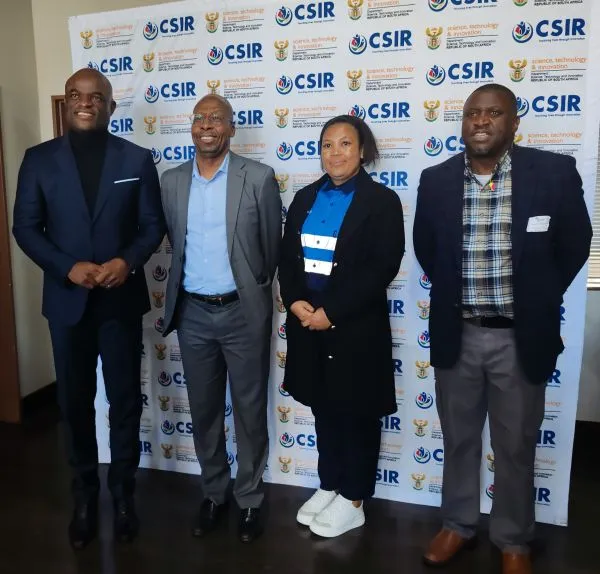
Dr Sandile Malinga, Group Executive: CSIR Smart Society, set the programme in motion with an overview of the CSIR’s strategic focus areas, including its working history with the Northern Cape, highlighting that the province is already using services offered by the National Integrated Cyber Infrastructure System, notably the Square Kilometre Array and SARAO racks, which are supported at the CHPC.
The two-and-a-half-hour tour provided educational, institutional and research-focused insights to the visiting group, who expressed appreciation for the exposure to the CHPC’s Dell HPC system, which comprises 1 039 Dell PowerEdge servers. These are the physical, large server cabinets that house South Africa's national supercomputing clusters containing thousands of stacked computing nodes, graphics processing units (GPUs), and high-capacity storage arrays used by researchers and universities.


Northern Cape Premier Dr Zamani Saul along with representatives from the Department of Science, Technology and Innovation, and the South African Radio Astronomy Observatory visited the Square Kilometre Array infrastructure in the Western Cape, including the CSIR’s Centre for High-Performance Computing on Thursday, 9 July 2026
Premier Saul remarked that not only are several astronomy programmes being powered by the CHPC, but they are also astronomy-focused, as some 72 researchers are running astronomy projects on CHPC infrastructure.
The CHPC acts as an essential engine for scientific research and technological innovation, owing to its ability to provide the massive computational power, high-speed networking and essential data management to academia, industry and the public sector required to solve problems that are too large or complex for standard computers.
“As a national research infrastructure facility, the CHPC enables South Africa’s research community to achieve its scientific and innovation objectives through advanced computing capabilities,” said CHPC Director Mervyn Christoffels. “Our focus extends beyond infrastructure. We are investing in the development of local skills, data ecosystems and strategic partnerships to ensure that South Africa has the capabilities needed to build and sustain sovereign digital and cloud platforms that support research, innovation and economic growth.”
With a focus on enhancing and capacitating the state and positioning the Northern Cape with other opportunities, Christoffels emphasised the critical factors influencing readiness for data-intensive industry growth and highlighted the changing nature of scientific discoveries, drawing attention to digital research.


CSIR principal system administrator Eric Mbhele and facility technician Kevin Blows led a tour of the CHPC’s facilities, viewing and engaging with various hardware infrastructure.
Dr Jabu Mtshweni, CSIR Executive Cluster Manager: NextGen Enterprises and Institutions, indicated the CSIR's readiness to partner with the Northern Cape province and seize fourth industrial revolution technologies that will promote digital sovereignty for the country.
Engagements during the tour clearly showed that future cyber infrastructure cannot depend on just a single structure. “One of the key lessons we have learned is that we cannot do this alone. Partnerships are critical. In today's knowledge economy, success is not determined by what we can extract, but by what we can create through skills development, innovation, collaboration, and the generation of new knowledge,” Christoffels added.
“We’re excited to hear that the Northern Cape is looking into having an artificial intelligence policy developed,” said DSTI Chief Director of Astronomy Takalani Nemaungani during his closing remarks.
Premier Saul indicated that his office intends to remain engaged with the CSIR and outlined a series of industrial and research opportunities underway in the Northern Cape, wherein the capabilities witnessed during the excursion stand to add value to the province's technology landscape.
Published 27 July 2026