It is estimated that by 2030, up to eight million tonnes of solar photovoltaic (PV) waste could accumulate globally, rising to 78 million tonnes by 2050 under early-loss scenarios. Researchers at the CSIR are calling for the adoption of harmonised international standards for the testing and requalification of second-life solar panels to ensure safety, reliability and performance in reuse applications.
End-of-life solar PV modules typically retain around 80% of their original efficiency, while early retirement results in modules with higher efficiencies entering the waste stream. To accelerate circularity, CSIR principal researcher Prof. Suzan Oelofse recommends adopting international standards that cover the full value chain of PV reuse, including decommissioning and sorting, labelling and certification, testing and requalification, as well as inspection and ongoing performance monitoring.
“In South Africa, increasing solar deployment is already leading to growing volumes of functioning panels entering the waste stream, despite limited recycling options and restrictions on landfill disposal, highlighting the urgency,” says Oelofse. “This emphasises the urgent need for standards to guide reuse and unlock circularity.”
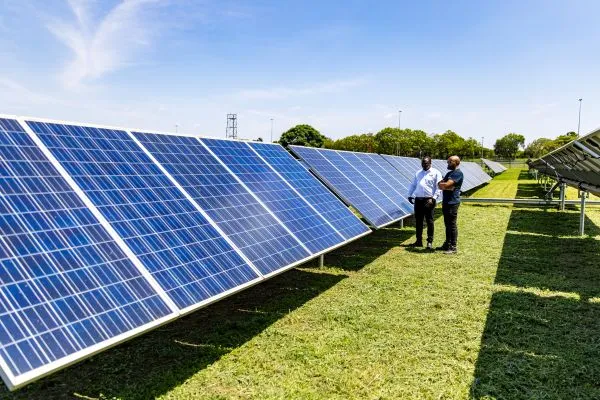
She adds that the country’s ongoing grid instability and rolling blackouts could serve as a strong incentive for reuse standards, enabling the deployment of lower-cost PV solutions while simultaneously addressing a growing waste management challenge.
Unlocking reuse at scale requires trust that second-life modules are safe, reliable and economically viable. “This must be tailored to local contexts and require investment in testing infrastructure, reuse facilities and skills development, particularly in the Global South,” Oelofse says. “A key challenge is that solar panels are not designed for circularity. Reuse must therefore be carefully regulated from decommissioning through to redeployment.”
Scaling PV panel reuse is coupled with a myriad of challenges, including technical variability (design, age and condition), declining costs of new PV modules and the need to build market confidence. Transparent labelling, certification and warranties for second-life modules will be critical to building trust among industry and consumers.
Oelofse adds that the panels cannot easily be modified; for example, cracked glass cannot be replaced and that system design limits their adaptability for alternative applications. “It would be great if new panels could be designed with reuse and circularity in mind.”
Many panels are decommissioned prematurely due to repowering, storm damage or warranty issues, accelerating the flow of PV waste. Strengthening governance mechanisms, including Extended Producer Regulations, could support more effective reuse pathways within an enabling policy environment.
Solar PV technology remains central to the renewable energy transition, but its long-term sustainability depends on effective life-cycle management. While improper handling of end-of-life panels poses environmental risks, a circular approach focused on extending product lifespans can significantly reduce waste. This includes testing, refurbishing, minor repairs and repurposing modules for secondary or lower-power applications rather than disposal.
Although PV panels are not currently designed for repair or repurposing, more than 85% of a solar PV module consists of recyclable materials such as aluminium and glass. Recovering valuable materials, including silicon, silver, copper and steel, can further reduce environmental impacts, although recycling remains costly and technically complex.
Oelofse encourages the prioritisation of PV panel reuse over recycling where feasible. “Recycling alone will not deliver circularity. It is expensive, technically challenging and often inefficient at recovering high-value materials. Reuse extends product lifetimes, preserves embedded energy and materials and avoids premature waste,” Oelofse says.
Ultimately, extending the life of PV panels, particularly those retired early due to upgrades or minor damage, offers a practical pathway to bridge renewable energy deployment and waste management objectives. Recycling should remain the last resort, applied only when panels can no longer be safely or effectively reused.
Published 8 June 2026