New pharma tech yields first local batch
South African researchers have successfully used a new technology to produce Celecoxib, the active ingredient in a common anti-inflammatory pain drug that is currently only available to private sector patients.
The production process for this active ingredient was recently scaled up at the CSIR’s new FuturePharma facility in Pretoria, using an emerging technology called continuous flow chemistry. This builds on foundational research conducted by the University of Pretoria.
“In the private sector, Celecoxib is a routine treatment but in the public sector people don’t readily have access to it,” explains CSIR chief researcher Dr Jenny-Lee Panayides. “So, if you have an inflammatory disease like rheumatoid arthritis, you are often given alternatives that don’t provide adequate relief.”
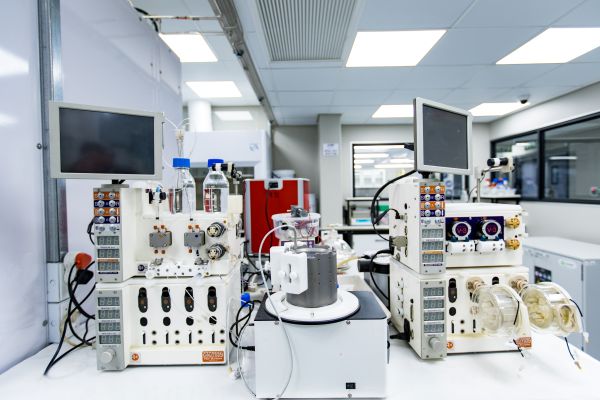
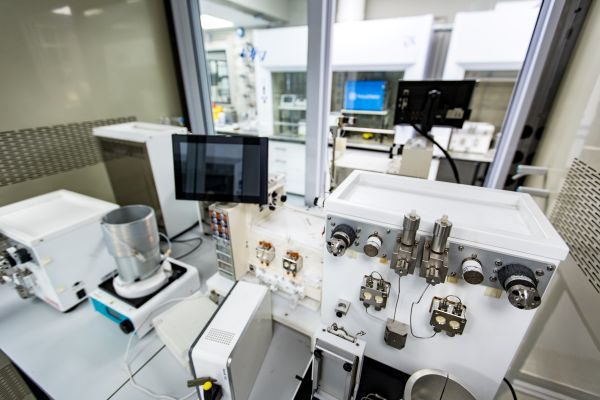
Benchtop continuous flow reactors and integrated analytical equipment at the CSIR’s FuturePharma facility enables initial proof-of-concept process development. Once the drug ingredient production process is established here, it can be upscaled using the CSIR’s large continuous flow facility.
She says this problem originally prompted researchers at the University of Pretoria to devise an affordable way to produce Celecoxib locally. With funding from the Department of Science, Technology and Innovation, they patented a continuous flow process at laboratory scale and then partnered with the CSIR to establish the industrial-scale process.
Continuous flow production has many advantages over traditional batch manufacture and this ultimately lowers the cost of drugs. Instead of a single bespoke factory that produces one active pharmaceutical ingredient en masse in giant vats, in a continuous flow facility the chemical reactions occur in a continuously flowing stream through tubes. The reactions can by tightly controlled, so the process is safer, more efficient and more precise.
The facility also has a much smaller footprint, both in terms of space and environmental impact. “We’ve measured these green chemistry parameters for our Celecoxib production, for instance; you use less electricity, less water and there are fewer by-products and less wasted solvent.”
Critically, a single plant can also produce many different types of drug ingredients, in any amount required.
While Celecoxib is a molecule potentially required in huge quantities to help treat arthritis, menstrual cramps and other inflammatory pains, the same continuous flow facility can even produce drug ingredients required in small amounts for rare disease therapies, without needing massive additional investment from the manufacturer.
“Big Pharma typically produces low-volume drugs at a high cost because they've got to have a whole production facility for a very small run,” says Panayides.

Even for hazardous or toxic drugs, like highly potent cancer chemotherapies, continuous flow offers advantages. “Those typically must be manufactured under extreme conditions, with workers wearing hazmat suits and self-contained breathing apparatuses to avoid exposure. With continuous flow, you only ever handle small amounts, so it is much safer than batch manufacture.”
The CSIR’s FuturePharma facility is home to Africa’s first large-scale continuous flow pilot plant.
“We’ve invested heavily in the localisation of this technology. The active pharmaceutical ingredient manufacturing industry is limited in the country and on the continent, so continuous flow gives us a leapfrogging advantage over legacy investments in batch facilities,” says Panayides. “It's an industry that we want to establish and we want to allow for backward integration of existing companies and new entrants that can fill this gap.”
She says that the CSIR works with companies to develop their process for kilogramme-scale production, following which the company would set up their own continuous flow facility and begin manufacturing.
“They will have access to all our data to build a good business case for investment in their own production facility. They would then buy commercial equipment that is similar, if not the same as what we’ve got,” she says. “We would then do a direct technology transfer, with no additional scaling up required.”
Panayides says the Covid-19 pandemic was a wake-up call for Africa to establish its own pharmaceutical manufacturing sector and become less reliant on imports. “With borders closed at that time, there was a worldwide shortage not just of Covid-19 vaccines, but also antibiotics, anaesthetics and many other active pharmaceutical ingredients,” she says.
Celecoxib, for instance, is not a finished drug product; it is an active ingredient that still needs to go to another factory to be put into a tablet, capsule or syrup form as a pain medication. While South Africa has an established industry in formulating and packaging drugs, most of the active ingredients are currently imported, despite making up a large portion of the cost of the final drug one buys at a pharmacy.
“What most people misunderstand is that while South Africa has fantastic multinational and local companies doing formulations, we need to secure our own active ingredient supply.”
Local manufacture is therefore the way to go, says Panayides, adding that local academia and basic research play a crucial role in establishing Africa’s pharmaceutical industry.
The Celecoxib success emanating from the University of Pretoria shows that the CSIR is well placed to catalyse the shift. “We're building an open innovation facility and we’ve shown that we can work together and that this model actually works,” she says.
For Panayides, it’s about building an ecosystem of research and industry that supports wider access to medicines, especially in the public sector. “As the CSIR, we want to improve the quality of life of South Africans, so we would like to see the Department of Health having affordable access to drugs like Celecoxib. While it is not a life-or-death drug like an antibiotic, it will drastically improve quality of life for patients.”
Her team is currently in talks with local manufacturers to produce Celecoxib under licence from the CSIR and she invites other universities and pharmaceutical companies to partner with them for other avenues of research and product development.
More information about our research, facilities and services:
https://www.csir.co.za/what-we-do/chemicals-and-materials/pharmaceutical-technologies
More innovations from the CSIR's world-class facilities in the latest edition of the CSIR ScienceScope magazine.
Published 12 May 2026