News

workshop
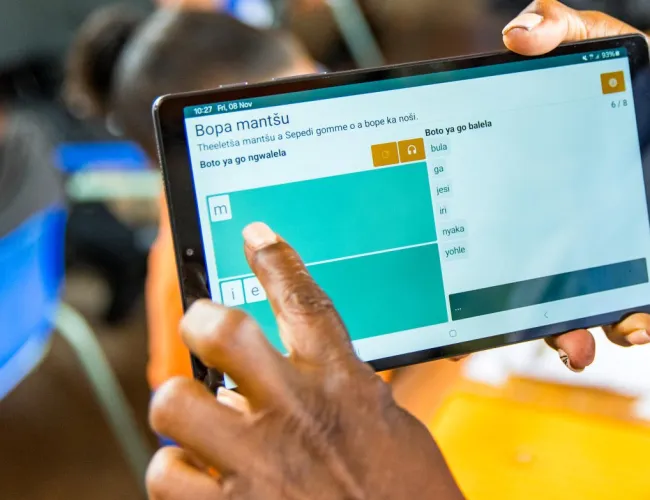
CHPC facilitates rollout of the new national coding and robotics curriculum

Forty provincial educational specialists responsible for the robotics and coding subject from eight provinces are attending the Department of Science,…

View More
CHPC Student Cluster Competition
Registrations are open for the CHPC Student Cluster Competition selection round

The Centre for High Performance Computing (CHPC) invites applications from suitably qualified candidates to participate in the CHPC Student Cluster…

View More
IPBES
“What does a ‘good quality of life’ look like?” asks CSIR expert on Second IPBES Global Assessment

Dr Phumza Ntshotsho from the CSIR’s Biodiversity and Ecosystem Services research group joined over 200 multidisciplinary experts from all over the world…

View More
The CSIR Advanced Fire Information System (AFIS) Map Viewer showing MODIS and VIIRS-detected fire activity across the Western Cape province over one month during the fire season (February–March 2026) accessible via AFIS Map Viewert that will enhance landscape resilience and address the impacts of damaging wildfires.
From Fynbos to flames – making global Mediterranean landscapes wildfire-smart

Relief is underway for wildfire-prone areas in the Western Cape and Catalonia in Spain with the Mediterranean Climate Action Partnership Mini-Sprint project…

View More
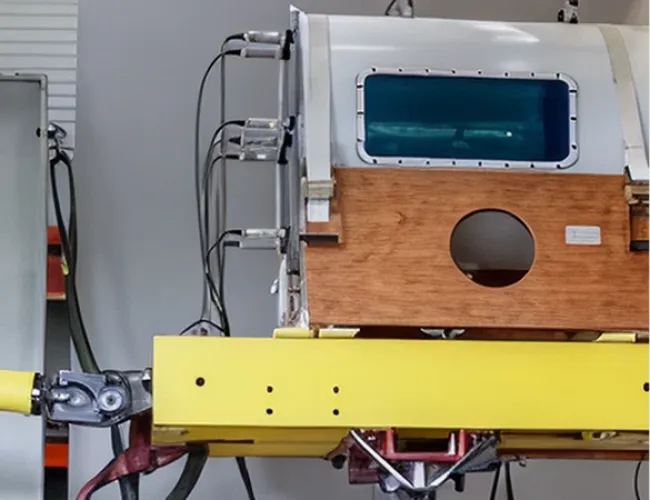
Underwater testing facility
Sink and sync: Underwater Wi-Fi to transmit sonar images almost instantly

How we are creating near real-time “eyes and ears” from ocean depths CSIR researchers say underwater drones will soon be able to broadcast high-resolution…

View More
mossel bay wastewater
Mossel Bay wastewater turns green, naturally

On the outskirts of Mossel Bay, a series of wastewater ponds are quietly doing important work. Water that enters the system as untreated effluent leaves…

View More
estuary management team
Flowing forward with a national estuary management course

Strengthening South Africa’s efforts in managing its aquatic ecosystems, such as estuaries, is vital for water and food security. In response, a team of…

View More
mercury testing
Chemical signals in the sediment

Pollution often develops gradually. Long before it causes obvious or large-scale environmental damage, it leaves subtle chemical fingerprints in rivers,…

View More
Immobazyme
South Africa now makes critical molecule for lab-grown meat 

A local biotechnology firm announced that it will produce a key molecule used internationally to grow meat products more sustainably. This follows the…

View More
BIDF Facility
South Africa’s biorefinery journey: From innovation to industrial impact

Imagine transforming forestry waste and agricultural by-products, such as sawdust and sugarcane residues, into high-value green chemicals, advanced materials,…

View More
clin-map platform article
African researchers to map biodata of African cancer patients

The CSIR has partnered with Ghanaian biotech firm Yemaachi to map African cancer patients’ DNA, RNA and proteins. In February 2025, Yemaachi and global…

View More
Road deaths article
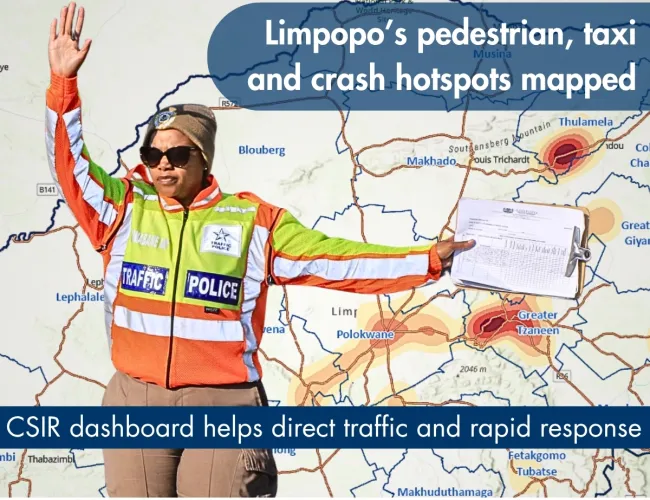
Scientists on the scene as road deaths climb

Bystanders and motorists rely on driver assistance technology, road restraint systems and other safety features to reduce harm in case of a crash, but the road…

View More
5G connectivity
Expanding 5G connectivity in rural communities through dynamic spectrum access innovation

Innovation in spectrum management is no longer an abstract policy debate confined to research papers and conference rooms. Today, it is a practical driver for…

View More
Wound healing
Take our wound-healing salve to the shelf

CSIR researchers have created market-ready protective microcapsules containing a novel wound-healing formulation. Studies confirm that the microcapsules, which…

View More
RoadMap conference banner
A decade of waste research, development and innovation in South Africa

The Council for Scientific and Industrial Research (CSIR) is hosting an online conference, The Waste Research, Development, …

View More
UNESCO report
UNESCO’s new roadmap for ocean carbon research

The ocean absorbs around 25% of carbon dioxide from human activities, but a new report warns that more research is needed to understand how the ocean carbon…

View More